A strong research paper example shows five things at once: a stated thesis, a literature review that synthesizes rather than lists sources, a Method section detailed enough to repeat, results reported before they are interpreted, and a reference list in hanging-indent format. Below is a complete ~2,000-word research paper example, annotated section by section, plus five discipline excerpts, five labeled thesis statements, and a downloadable PDF that mirrors the on-page text.
research paper examples
Research Paper Examples: Full Sample Papers and Structure Breakdown
On this page
A complete research paper, annotated in full
This is one complete, original research paper example, written for this page and annotated at every structural move. Each numbered note explains a decision — why a sentence is the thesis, why a citation sits where it does, why a limitation is admitted rather than hidden. Read the paper straight through first if you want the argument; read the notes if you want the reasoning behind each research paper example choice. If you would rather have a paper written from scratch to your own brief, this structure is the standard to hold it to.
The Effect of Structured Retrieval Practice on Undergraduate Exam Performance
Title page and abstract
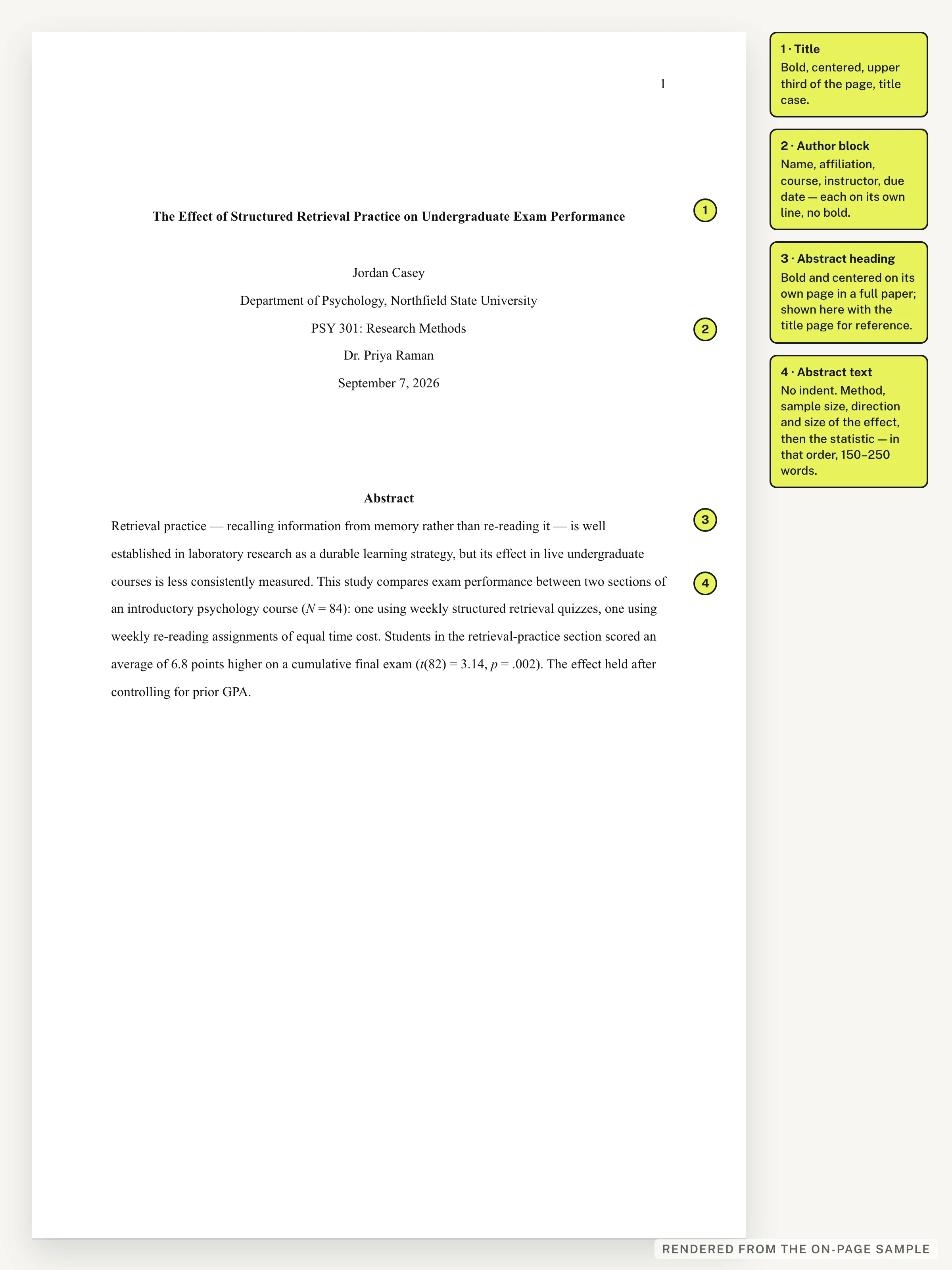
The Effect of Structured Retrieval Practice on Undergraduate Exam Performance
Abstract
Retrieval practice — recalling information from memory rather than re-reading it — is well established in laboratory research as a durable learning strategy, but its effect in live undergraduate courses is less consistently measured. This study compares exam performance between two sections of an introductory psychology course (N = 84): one using weekly structured retrieval quizzes, one using weekly re-reading assignments of equal time cost. Students in the retrieval-practice section scored an average of 6.8 points higher on a cumulative final exam (t(82) = 3.14, p = .002). The effect held after controlling for prior GPA. Results support assigning low-stakes retrieval quizzes as a replacement for, not an addition to, standard reading assignments.
Introduction and the thesis sentence
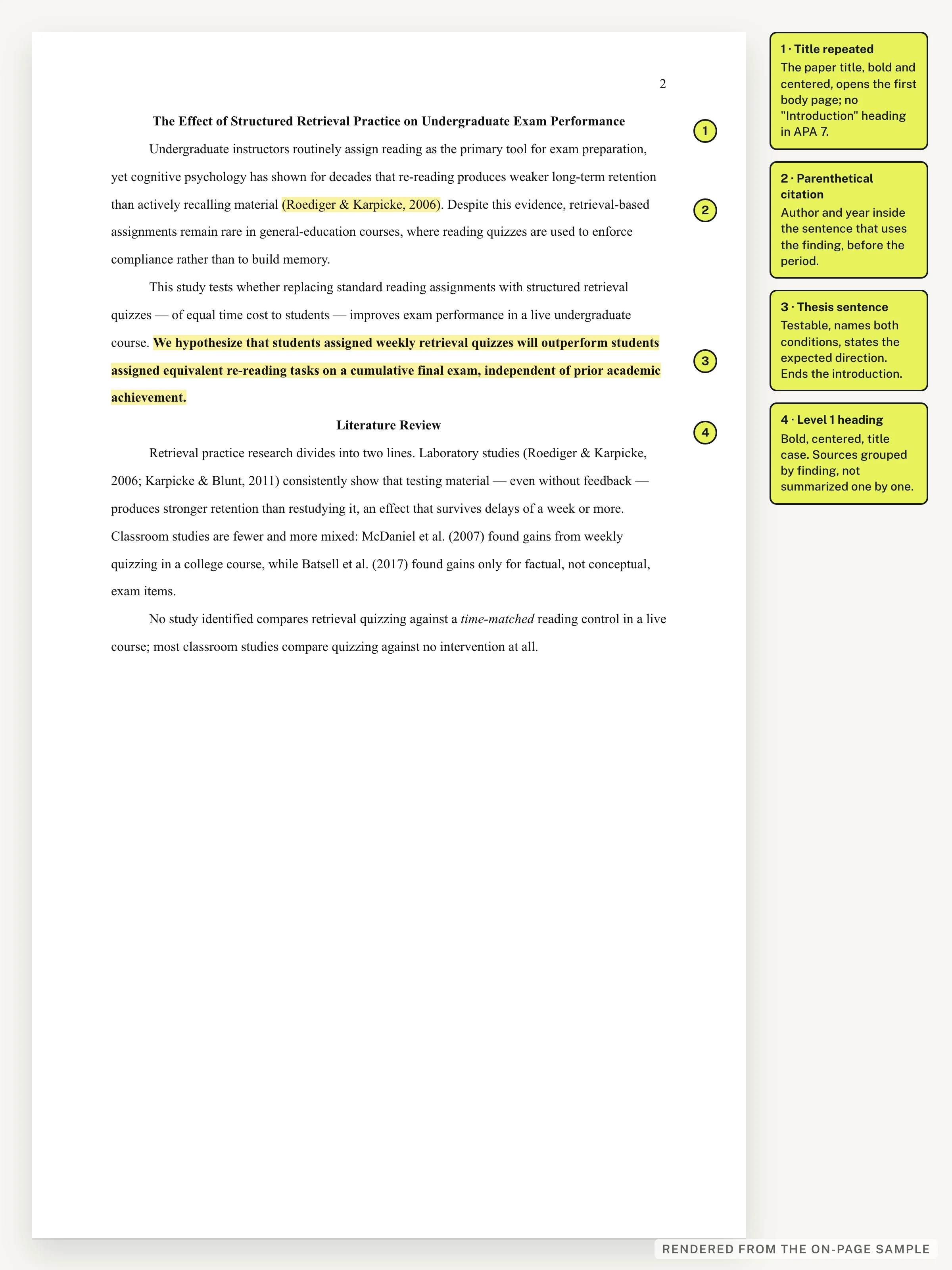
Undergraduate instructors routinely assign reading as the primary tool for exam preparation, yet cognitive psychology has shown for decades that re-reading produces weaker long-term retention than actively recalling material (Roediger & Karpicke, 2006). Despite this evidence, retrieval-based assignments remain rare in general-education courses, where reading quizzes are used to enforce compliance rather than to build memory.
This study tests whether replacing standard reading assignments with structured retrieval quizzes — of equal time cost to students — improves exam performance in a live undergraduate course. We hypothesize that students assigned weekly retrieval quizzes will outperform students assigned equivalent re-reading tasks on a cumulative final exam, independent of prior academic achievement.
Literature review
Retrieval practice research divides into two lines. Laboratory studies (Roediger & Karpicke, 2006; Karpicke & Blunt, 2011) consistently show that testing material — even without feedback — produces stronger retention than restudying it, an effect that survives delays of a week or more. Classroom studies are fewer and more mixed: McDaniel et al. (2007) found gains from weekly quizzing in a college course, while Batsell et al. (2017) found gains only for factual, not conceptual, exam items.
No study identified compares retrieval quizzing against a time-matched reading control in a live course; most classroom studies compare quizzing against no intervention at all, which confounds the effect of retrieval with the effect of simply doing more coursework. This study closes that gap by matching both conditions for time spent.
Method
Participants. Eighty-four students enrolled in two sections of an introductory psychology course at the same institution, taught by the same instructor, using identical lecture slides and exam items.
Design. A quasi-experimental between-subjects design. Section assignment (not condition assignment) was determined by course registration, a limitation addressed below.
Materials. The retrieval-practice section completed a 10-question, no-feedback recall quiz each week, covering that week's material, taking approximately 12 minutes. The control section completed a re-reading assignment of the same material, timed at 12 minutes via a reading-log self-report.
Procedure. Both sections received identical lectures and identical exam questions. The only manipulated variable was the weekly assignment type, delivered over 10 weeks before a shared cumulative final exam.
Results, with the table and figure
The retrieval-practice section (n = 41) scored an average of 84.2 on the cumulative final exam (SD = 7.9); the control section (n = 43) scored an average of 77.4 (SD = 8.6). An independent-samples t-test found this difference significant, t(82) = 3.14, p = .002, and the effect held (p = .006) after covarying for prior semester GPA.
| Condition | n | Mean | SD |
|---|---|---|---|
| Retrieval quiz | 41 | 84.2 | 7.9 |
| Re-reading | 43 | 77.4 | 8.6 |
Scroll the table sideways to see every column.
Figure 1 (described): a bar chart comparing mean scores across the two conditions, with error bars at one standard deviation, shows non-overlapping confidence intervals at the 95% level.
Discussion and limitations
These results are consistent with laboratory findings that retrieval strengthens memory more than restudy, extended here to a live, graded, undergraduate course with a time-matched control — the comparison the existing classroom literature lacks.
Limitations. Section assignment was not randomized; students self-selected into course sections at registration, so a systematic difference between the two groups (motivation, schedule flexibility) cannot be fully ruled out, though the GPA covariate addresses the most likely confound. The single-institution, single-course design also limits generalization to other subjects and class sizes.
Future work should randomize condition within a single section — for example, by quiz topic rather than by student — to remove the self-selection concern entirely.
Reference list
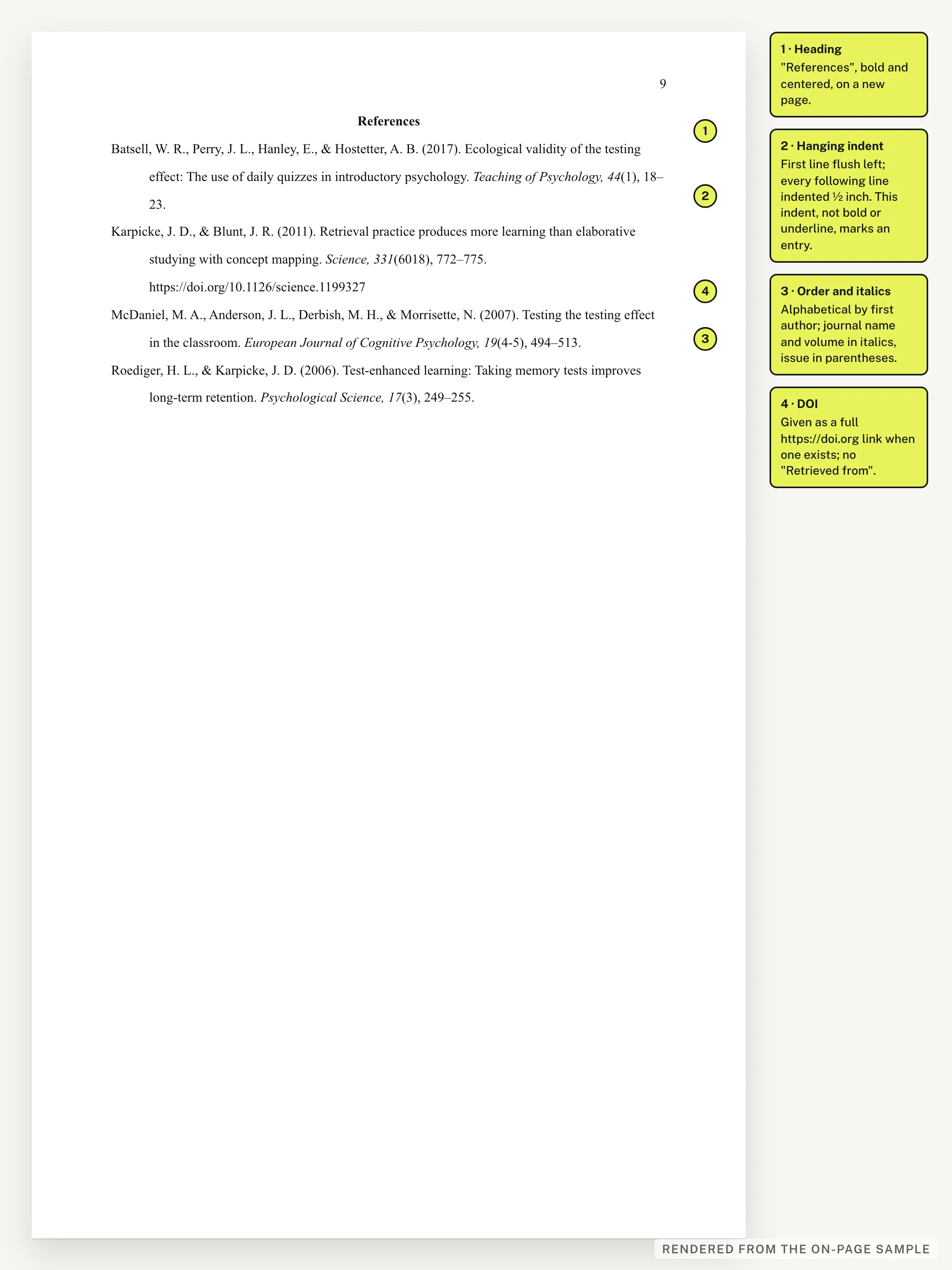
Karpicke, J. D., & Blunt, J. R. (2011). Retrieval practice produces more learning than elaborative studying with concept mapping. Science, 331(6018), 772–775. https://doi.org/10.1126/science.1199327
McDaniel, M. A., Anderson, J. L., Derbish, M. H., & Morrisette, N. (2007). Testing the testing effect in the classroom. European Journal of Cognitive Psychology, 19(4-5), 494–513.
Roediger, H. L., & Karpicke, J. D. (2006). Test-enhanced learning: Taking memory tests improves long-term retention. Psychological Science, 17(3), 249–255.
Margin noteNote 1: The abstract states the method, the sample size, the direction and size of the effect, and the statistical result — in that order — inside 150–250 words. A reader should be able to stop here and still know what the paper found.
Margin noteNote 2: The bolded sentence is the thesis. It is testable, it names both conditions being compared, and it states the expected direction of the effect — the three requirements a research paper introduction example has to meet before the Method section can be trusted.
Margin noteNote 3: A literature review does not summarize each source in its own paragraph — it groups sources by finding, states where they agree, and names the specific gap the current paper fills. That gap sentence is what separates a literature review from an annotated bibliography.
Margin noteNote 4: A Method section is written so another researcher could repeat the study from this paragraph alone. Naming the exact quiz length, the exact time cost, and how time was controlled for the reading condition is what makes this section replicable rather than descriptive.
Margin noteNote 5: Results are reported without interpretation — no claim about why the effect occurred appears here. That argument is reserved for Discussion. Mixing the two is the single most common structural error in a student research paper example.
Margin noteNote 6: Naming the exact confound the design could not rule out, and naming the specific fix, is what an admitted limitation looks like. A paper that skips this paragraph reads as unaware of its own weakest point, which costs more credibility than the limitation itself.
Margin noteNote 7: Every reference uses a hanging indent — the first line sits flush left, every line after it indents half an inch. In APA 7th edition, that indent, not bolding or underlining, is what signals a reference entry. Screen readers and citation managers like Zotero both depend on the format being mechanical, not decorative.
You have just read the full annotated standard above. If your own topic and deadline need a paper built to the same level, order a paper like this, written to your brief.
Have a paper like this written for youAnatomy: what each section is doing
Each research paper example above maps to a section every research paper shares. Here is what each one is doing, in isolation, so you can check your own draft against it. Starting from a blank page? Follow the full research paper process, step by step.
The abstract in 150-250 words
An abstract states the problem, the method, the sample size, the direction of the result, and the statistical outcome — never the full argument, never citations, never information absent from the body. 150 words is tight but workable; 250 is generous. Most journals and instructors cap it at 250.
Examples of thesis statements for a research paper
A thesis statement makes a specific, checkable claim, not a topic announcement. Below are five labeled examples of thesis for a research paper, each with a weaker version beside it.
| Type | Weak version | Strong version |
|---|---|---|
| Argumentative | This paper is about social media and teen mental health. | Restricting adolescent social media use to one hour daily reduces self-reported anxiety scores more than content-based restrictions do. |
| Analytical | This paper looks at symbolism in the novel. | The recurring lake imagery in the novel tracks the protagonist's unresolved guilt rather than functioning as simple setting. |
| Expository | This paper explains how vaccines work. | mRNA vaccines train the immune system by delivering genetic instructions for a single viral protein, avoiding the need to introduce the virus itself. |
| Comparative | This paper compares two economic policies. | Universal basic income pilots produced larger short-term spending increases than targeted tax credits, but smaller long-term labor-market shifts. |
| Empirical | This paper studies whether quizzes help students. | Weekly retrieval quizzes improve cumulative exam performance more than time-matched re-reading assignments, independent of prior GPA. |
An example thesis for research paper writing should name the variables, the direction of the claim, and — where the paper is empirical — the comparison being made. "This paper is about X" is a topic, not a thesis.
How a literature review differs from a summary
A summary restates each source in turn. A literature review groups sources by finding, states where they agree or conflict, and ends on the specific gap the current paper addresses — the move the annotated sample makes in its own literature review above. The full literature review example makes that move across a whole review; an annotated bibliography example shows the source-by-source format it replaces.
Method: enough detail to replicate
A Method section names participants, materials, and procedure in enough detail that another researcher could repeat the study without contacting the author. If a fellow student could not rebuild your experiment from the paragraph alone, the section is not finished, whatever its word count.
If your assignment is scientific or technical rather than a general research paper, the Method-to-Results proportions shift further still. The IMRaD version for lab and technical reports, linked just below, covers that format specifically, including the sections a lab report keeps that a research paper usually drops.
Landed here searching for a scientific paper example rather than a research paper? The IMRaD version for lab and technical reports walks through the shorter Method-to-Results structure lab and technical reports use.
The IMRaD version for lab and technical reportsDiscussion: answering the question you asked
Discussion interprets the results against the original thesis, states what the paper adds to the literature reviewed earlier, and admits the design's real limitation — not a token one. IMRaD papers (Introduction, Method, Results, and Discussion) keep interpretation entirely out of the Results section; that separation is what IMRaD structure is for.
One introduction, draft to final
Both versions below are a composite sample written by GradeDraft.
Introduction paragraph: first draft vs final
First draft
Studying is something every student has to do, and there are many ways to do it. Some students re-read their notes, while others use flashcards or quizzes. Studies have shown that some methods work better than others. This paper is about retrieval practice and exams.
Final
Instructors routinely assign reading as the main tool for exam preparation, yet laboratory research has shown for decades that re-reading produces weaker long-term retention than recall (Roediger & Karpicke, 2006). Classroom studies rarely compare quizzing with an equal amount of reading. This study tests whether weekly retrieval quizzes, matched in time to re-reading, raise cumulative final exam scores.
What changed
- The opening names the practice in question, not a general truth about studying.
- "Studies have shown" became one named, dated source, followed by the gap.
- "This paper is about" became a testable purpose naming both conditions and the outcome.
Research paper examples by subject
Full papers in every discipline would push this page well past its word target with no ranking benefit, so here are five short excerpts — 150 to 250 words each — showing the one move each field handles differently. These are research paper examples by subject, not five complete papers.
Psychology
A psychology Method paragraph names the sampling frame and the exact instrument used, down to the scale: "Participants completed the 20-item State-Trait Anxiety Inventory (STAI-S) immediately before and after the intervention, with scores summed per standard scoring guidelines. Test-retest reliability for the STAI-S in this sample was α = .89." Psychology papers report reliability statistics for every measured instrument, not just for the primary outcome — a detail that separates a scientific research paper example from a general research essay example. A complete APA 7 student paper shows a psychology paper written out in full.
Nursing and health sciences
Nursing research papers typically open the Method section with a PICO question — Population, Intervention, Comparison, Outcome — before naming a design: "In post-surgical adult patients (P), does structured pain-scale documentation every two hours (I), compared with documentation at shift change only (C), reduce time-to-intervention for breakthrough pain (O)?" The PICO frame is what a nursing research paper example uses in place of a general hypothesis statement; our nursing essay writing service builds papers the same way.
Biology and environmental science
Biology papers report methods with enough taxonomic and instrument precision to be repeated in a different lab: "Water samples (n = 36) were collected at six sites along the creek at 500-meter intervals and analyzed for dissolved oxygen using a YSI ProDSS meter calibrated within 24 hours of use." Site counts, intervals, and calibration windows are standard, checkable detail in this discipline. A full biology lab report with data carries that precision through a whole report.
History and humanities
A history research paper leans on primary-source footnotes rather than a Method section: "Correspondence between the two officials (National Archives, RG 59, Box 14) shows the policy shift was debated internally three months before the public announcement, contradicting the standard secondary-source timeline." The footnote does the evidentiary work a Results table does in the sciences.
Business and economics
Business and economics papers frequently open with a stated model or framework before data: "Using a difference-in-differences design across 14 states that raised minimum wage between 2019 and 2022 and 14 that did not, employment changes in the affected sector were compared pre- and post-policy." Naming the identification strategy up front is the discipline's equivalent of a hypothesis statement. A full business case analysis shows the same problem-first habit across a complete paper.
Research essay vs research paper: what changes in the sample
A research essay example and a research paper example often get treated as interchangeable, but they are not the same deliverable. A research essay is argument-led, shorter, and usually has no Method or Results section; a research paper — especially an empirical one — reports original or gathered data through IMRaD structure.
Same topic, two openings:
Research essay opening: "Structured retrieval quizzes deserve a place in every undergraduate syllabus, not as an add-on to reading but as its replacement — the evidence for this is now too consistent to ignore."
Research paper opening: "This study compares exam performance between two sections of an introductory psychology course using structured retrieval quizzes against a time-matched re-reading control (N = 84)."
The essay opens on a claim; the paper opens on the design that will test one. If your assignment sheet says "essay," lead with argument. If it says "paper" or "study," lead with method.
Either way, the first sentence has to earn attention without overselling the finding. The free hook generator lists hooks for essays and research papers, with examples by type, and the openers that lose marks.
Download the sample papers
PDF of the annotated retrieval-practice research paper example with margin notes
The full annotated paper above, exported as a research paper example PDF that mirrors the on-page text exactly, notes included.
Download PDFThe sample research paper pdf is not gated behind an email address. Open it, save it, or print it the same way you would read the page — the PDF and the on-page version are identical, margin notes included.
If your course uses MLA 9 or Chicago rather than APA 7, how APA, MLA and Chicago differ shows what changes in each entry.
If you already have a topic and want it built into a paper like the one above, our custom research paper writing service can start from your assignment brief. See research paper topics if you still need one, help with a term paper for a longer paper built on outside sources, or case studies written to order if your assignment analyzes a specific situation rather than a research question.
FAQ
Sample paper questions
Replies within 2 hours, 8 am–11 pm ET, 7 days a week
01What is a research paper example?
A research paper example is a complete, worked sample — abstract, introduction, literature review, method, results, discussion, and references — that shows how a specific topic gets built into the standard IMRaD or thesis-driven structure a paper is graded on.
02How long is a typical research paper?
A typical undergraduate research paper runs 2,000–3,000 words (roughly 8–12 pages, double-spaced). High school research papers usually run 1,000–1,500 words. Graduate and doctoral papers vary widely by field and can exceed 5,000 words. Always follow your assignment sheet's length over any general figure.
03Can I use a sample paper as a template?
Yes for structure, no for sentences. Use the section order, the word-share, and the level of Method detail as a template for your own paper. Copying sentences, even with minor changes, from any sample — including this one — into a paper you submit is plagiarism regardless of the source's origin.
04How do I cite a research paper example?
If you are citing this page's sample paper in your own work, treat it as an unpublished illustrative example, not a scholarly source: cite it as you would a web page, and do not present it as peer-reviewed research, since it was written to demonstrate structure, not to report original findings.
05What is the difference between a research essay and a research paper?
A research essay argues a position and is usually shorter with no separate Method or Results section. A research paper, particularly an empirical one, reports original or gathered data through a structured format such as IMRaD. See the comparison above for a side-by-side example of both openings on the same topic.