A value makes an equation true when substituting it for the variable leaves the left side numerically equal to the right side. To find what value of y makes the equation true, plug the candidate in, compute both sides separately, and compare. For , works: the left side becomes , matching the right side exactly.
what value of y makes the equation true
What Value of y Makes the Equation True? Solving Equations Step by Step
On this page
- The short answer: substitute it and see
- Check your candidate value here
- What does it mean to solve an equation?
- Worked examples: what value of x or y makes each equation true
- Checking a candidate solution by substitution
- How many solutions does an equation have - one, none, or infinitely many
- Solve the following equation for x: the five-step method
- Solving analytically vs graphically vs guess-and-check
- Rewriting an equation as a function of x - and why that is not solving
- When the whole problem set is due tonight
The short answer: substitute it and see
Solving an equation means finding the value that makes it true, and checking is simpler than solving: substitute the candidate for the variable, simplify each side on its own, and compare the two results. If they match, the equation is true for that value. If they don't, it isn't — no further algebra is needed to find that out.
Take with the candidate .
Both sides equal , so is what value of y makes the equation true. That's the whole method behind finding what number makes the equation true for any equation you're handed: substitute the candidate, simplify each side on its own, and compare.
Check your candidate value here
A lot of the top results for equation questions are locked one-question answers on Brainly, Chegg, or Quora — you land on the page, and either the specific number in your problem doesn't match theirs, or the answer sits behind a login wall. Checking your own candidate value doesn't require finding a matching post. The tool below substitutes your value into your equation, computes each side, and returns TRUE or FALSE with the arithmetic shown — it deliberately does not solve the equation for you.
How the checker substitutes
Enter an equation with one variable and a candidate value for that variable. The checker replaces every instance of the variable with your value, evaluates the left-hand side and the right-hand side separately, and shows the arithmetic for each — no hidden steps, no rounding until the final comparison.
What 'true' looks like when the two sides match
When the two computed numbers are identical, the checker returns TRUE. That candidate is a genuine solution to the equation, and you can write it down with confidence instead of trusting a stranger's posted answer.
What it means when they do not
When the two sides come out different, the checker returns FALSE. That doesn't necessarily mean your method was wrong — it means this particular candidate isn't the solution. Go back to the equation, resolve it, and check the new candidate the same way.
What does it mean to solve an equation?
What does it mean to solve an equation, in plain terms? It means finding every value of the variable that makes the equation a true statement, rather than a false one. An equation is a claim about equality; solving it is the process of discovering which numbers make that claim hold up.
Solution, root, zero: three words for the same thing
A solution is a value that makes the equation true. When the equation is written as something equals zero, that same value is called a root or a zero. All three words point at the identical number — the label just depends on how the equation was framed when someone asked the question.
Why an equation is a claim, not an instruction
A linear equation like isn't a command telling you to do something to ; it's a claim that a specific relationship holds. Solving it means testing which value of the variable turns that claim into a true statement, using the coefficient and the operations already present, not inventing new ones. The same substitution check is the fastest way to protect points under a clock, which is why our timed practice before an algebra test drills it, and a worksheet of thirty equations you would rather not work alone can go to a specialist as a one-file assignment order.
What is a math solution?
What is a math solution? It's the number (or numbers) that satisfy an equation when substituted in — nothing more mysterious than that. A math solution isn't an approximation or a best guess; it's a value that survives the direct substitution check, LHS equal to RHS, exactly.
Worked examples: what value of x or y makes each equation true
These ten algebraic equations examples are worked in full below, and the first six include the exact items showing up as gated, single-question posts across UGC sites right now. Each closes with the substitution check rather than stopping at the answer, so you can see what values of x make the equation true and confirm it yourself.
One-step: 3x = 12
Divide both sides by the coefficient, 3: . Check: LHS ; RHS . They match, so .
Two-step with a negative: -2y - 9 = -11
Add 9 to both sides:
Variable on both sides: 12y - 1 = 9y + 8
Subtract from both sides: , so . Add 1: . Divide by 3: . Check: LHS ; RHS . They match, so .
Fractions and decimals: 12y - 1/2 = 9y + 8/5
Subtract : . Add to both sides, using a common denominator of 10:
A radical: sqrt(34) x sqrt(y) = 34
Combine the radicals: . Set that equal to 34 and square both sides:
Algebraic equations that equal 2
A quick set of sample algebraic equations with answers, all sharing the solution : ; ; . Check the second one: LHS
Decimals only: 0.4x + 1.2 = 2.8
Multiply every term by 10 to clear the decimals: . Subtract 12: . Divide by 4: . Check: LHS
Fractions with unlike denominators: x/3 + x/4 = 7
Multiply every term by 12, the least common denominator of 3 and 4: . Combine like terms: . Divide by 7: . Check: LHS
Parentheses on both sides: 3(x - 4) = 2(x + 1)
Distribute on each side first: . Subtract : . Add 12: . Check: LHS
A negative coefficient on one side: 5 - 2x = 3x - 10
Add to both sides so the variable term stays positive: . Add 10: . Divide by 5: . Check: LHS
Checking a candidate solution by substitution
Checking a candidate before you commit to it catches mistakes that a "final answer" box hides. The method is always the same two-column comparison: compute the left-hand side, compute the right-hand side, and see whether they land on the same number.
The two-column check (LHS | RHS)
| Left-hand side (LHS) | Right-hand side (RHS) |
|---|---|
Both columns land on 35, so the candidate checks out.
Which equation is true when you are given four choices
Multiple-choice items ask which equation is true for a stated value — solve nothing, just substitute into each option. Given , which equation is true?
- A)
- B)
- C)
- D)
Option C is the equation that is true. Substituting into all four takes less time than solving any one of them from scratch.
Why the check catches sign errors that the solve step hides
A dropped negative sign during solving still produces a number — it just isn't the right one. The substitution check is where that error surfaces: the two sides won't match, and you'll know to re-check your work before you submit it, rather than after it's graded.
How many solutions does an equation have - one, none, or infinitely many
How many solutions does the following equation have depends entirely on what happens to the variable once you simplify. There are exactly three possible outcomes, and each has a distinct tell.
| Outcome | Example | What happens when you solve | The tell |
|---|---|---|---|
| One solution | , a single number | The variable survives to the end | |
| No solution | The variable cancels; a false statement remains | ||
| Infinitely many | The variable cancels; a true statement (an identity) remains |
Scroll the table sideways to see every column.
One solution: variables survive
Most equations you'll meet in a homework set land here. After simplifying, one copy of the variable is still standing, and isolating it gives a single number — the equation's one and only solution.
No solution: a false statement like 5 = 7
When the variable cancels out and what's left is false — like — the equation has no solution. No value of the variable can make a false numerical statement true, no matter what you substitute.
Infinitely many: an identity like 0 = 0
When the variable cancels and what's left is true — like or — the equation is an identity. What are the solutions to the equation in that case? Every real number, because the original equation was really the same expression written twice.
Classify any equation in three steps
- Simplify both sides fully: distribute, then combine like terms on each side.
- If the variable terms are identical on both sides, compare the constants: equal constants mean infinitely many solutions, different constants mean no solution.
- Otherwise the equation has exactly one solution, so solve for it and check it by substitution.
| Equation | After simplifying | Answer |
|---|---|---|
| Infinitely many: the two sides are identical | ||
| on both sides, but | No solution | |
| One solution, | ||
| Infinitely many: the two sides are identical |
The one-solution item checks out by substitution: LHS ; RHS .
Solve the following equation for x: the five-step method
Solve the following equation for x using the same five moves every time, regardless of how the equation is dressed up with fractions or parentheses. Working example:
1. Clear fractions and parentheses
Multiply every term by the least common denominator of 2 and 3, which is 6:
2. Collect like terms
Combine on the left: .
3. Move the variable to one side
Subtract from both sides: .
4. Isolate
Add 6 to both sides: .
5. Substitute back to verify
LHS
Solving equations for the variable when it appears on both sides
Solving equations for the variable when it appears on both sides just adds one move before step 3: collect every variable term onto a single side first. For : subtract , giving ; subtract 7, giving ; divide by 2, giving . Check: LHS
Solving analytically vs graphically vs guess-and-check
There's more than one legitimate route to a solution, and knowing which one the question is actually asking for saves time on a test.
Solve the equation analytically: exact values
To solve the equation analytically means doing the algebra step by step, the way every worked example above does it, to land on an exact value — a fraction or a whole number, never a rounded decimal unless the question specifically asks for one.
Graphically: where the two sides cross
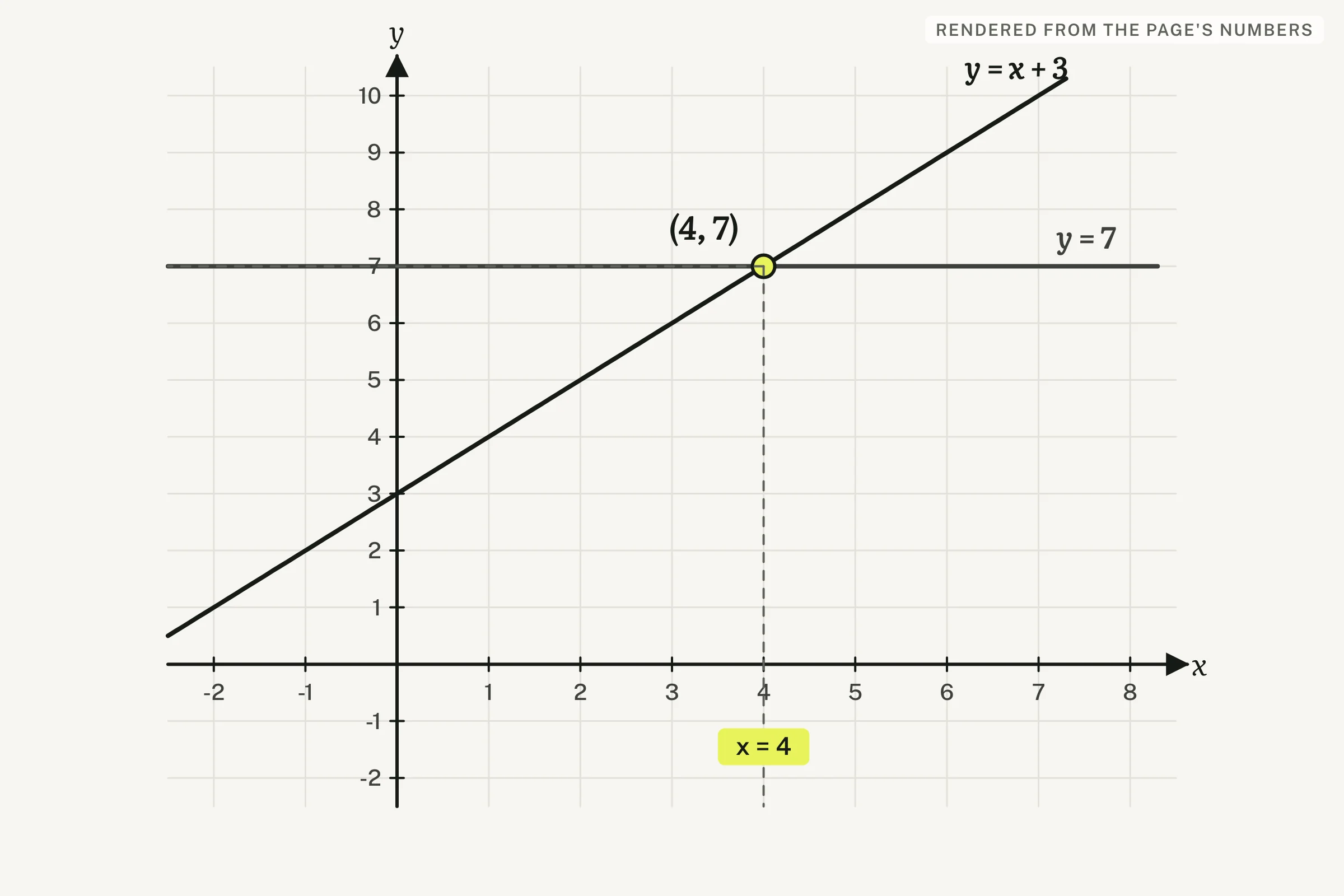
Graph the left side and the right side as two separate functions; wherever those graphs cross is the solution. For , graph and ; they meet at , matching the algebraic answer exactly. Desmos or a graphing calculator makes this a fast visual double-check, though it can be slower to set up than solving directly.
Seeing an equation as math pictures — a graph, not just numbers — is often the fastest way to confirm a solution belongs where you think it does. This picture of math turns an abstract equality into a single, unmistakable crossing point.
Guessing: when it is legitimate and when it loses marks
Guess-and-check is legitimate for a quick multiple-choice item with four candidates already given — substitute each one and see which fits, exactly like the section above. It loses marks the moment a rubric asks for shown work, because a correct final number with no algebra earns partial credit at best. If the reasoning itself is the sticking point rather than the arithmetic, a tutor on Wyzant or a structured Khan Academy lesson can walk through why each step is legal, which a guessed answer never explains. This is also the formal Guess-and-Check table that the CPM Algebra 1 course builds into its own method, just under a different name.
Rewriting an equation as a function of x - and why that is not solving
Rewriting an equation as a function of x looks like solving because it involves isolating a letter — but it isolates the wrong one, and no numeric solution comes out the other end.
Rewrite the following equation as a function of x
Rewrite the following equation as a function of x: start from . Isolate instead of finding a number: , so . That's a function of — for any -value you plug in, it hands back the matching -value on that line.
Solved for y vs solved for a number
Solving for (above) produces a rule, not a value — is still expressed in terms of . Solving an equation for a number requires a second piece of information. If you're also told , substitute it in:
When the whole problem set is due tonight
Checking one candidate value, the way this page teaches, takes under a minute once you know the method. A problem set with thirty equations — mixed one-step, both-sides, fractions, and direct variation — takes a lot longer, especially the night before it's due. That's the point where a lot of students go looking to pay someone to do my math homework instead of grinding through each item by hand.
GradeDraft's math desk, part of our do my homework service, solves equation sets like this one, with every step shown in the same substitute-and-verify format used above, priced from $25 per problem after a quick look at the set.
Send the assignment or a photo of it. You'll get a per-problem quote back within 2 hours (8 am–11 pm ET) and full worked steps with the delivery.
Get your equations problem set solvedTwo equations solved together needs a different method — see two equations at once: solving by elimination. Once the equation has an term, see when the equation has an x-squared term; switching between standard, vertex and factored form is a separate skill with its own guide. Proof-based problems belong on a different page: geometry help and two-column proofs.
FAQ
More questions about solutions and equations
Replies within 2 hours, 8 am–11 pm ET, 7 days a week
01What is the definition of an equation?
An equation is a mathematical statement that two expressions are equal, connected by an equals sign. It becomes a claim you can test: substitute a value for the variable, and the equation is either true for that value or it isn't.
02How do I solve an algebraic equation step by step?
Clear any fractions or parentheses first, collect like terms, move every variable term to one side, isolate the variable with inverse operations, and substitute your answer back into the original equation to verify it. That five-move sequence handles the overwhelming majority of equations you'll meet before calculus.
03What is a math solution?
A math solution is any value that, when substituted for the variable, makes the equation a true statement. An equation can have exactly one solution, no solution, or infinitely many, depending on what remains after the variable terms are combined.
04How do I know if my answer is right without an answer key?
Substitute your answer back into the original equation, not the simplified version. Compute the left side and the right side separately; if they land on the same number, your answer is correct — that's the same test used above to confirm what value of y makes the equation true, and it's the entire point of this page's substitution checker. The same substitute-and-compare logic checks a hypothesis-test statistic too; see z table and statistics basics for that version.
05Is rewriting an equation the same as solving it?
No. Rewriting an equation — isolating as a function of , for example — produces a rule connecting two variables, not a specific numeric answer. Solving produces one or more actual values that make the original equation true.
06What does it mean to solve an equation?
It means finding every value of the variable that turns the equation into a true numerical statement. The value itself is called the solution, the root, or the zero, depending on how the equation was phrased.
07What's the difference between an equation and an expression?
An equation has an equals sign and makes a claim you can check as true or false; an expression, like , has no equals sign and nothing to solve — it can only be simplified or evaluated at a given value of .
08Can an equation have more than one variable and still be solved?
Yes, but "solved" then usually means solved for one variable in terms of the other — the rewriting-as-a-function case above — rather than a single number. A two-variable equation only produces one specific numeric solution when a second condition, like a given value of , is supplied alongside it.