Geometry Help: Step-by-Step Answers, Proofs and Solved Problems
Search geometry help and most results gate their worked examples behind a membership video or block crawlers outright. This page does neither: four complete two-column proofs, a full reason bank, five worked problems by type, and a row-by-row proof revealer that trains the actual skill - picking the right reason - sit here in full, free, before any mention of paying GradeDraft to finish the rest. If a geometry test rather than homework is the deadline, a seven-day prep plan gives you timed practice and tutoring before the test.
Free revisions for 14 days (30 days for dissertation chapters and capstones)
Reply within 2 hours, 8 am–11 pm ET, 7 days
Written and reviewed by the GradeDraft STEM & homework desk.Last reviewed
¶ 1¶ 2¶ 3
Turnitin originality report included
After (graded two-column proof)p. 1
Solver output vs. a graded reason column (composite sample written by GradeDraft, Proof 1)
After (graded two-column proof)
The same conclusion, built from the reason bank one citable step at a time: Definition of linear pair → Linear Pair Postulate → Substitution Property of Equality → Subtraction Property of Equality → Definition of congruent angles.
— 1 —
Margin noteNothing upfront
Published prices · USD
Nothing upfront
Problem setfrom $25per problem
Programming taskfrom $79per task
Live tutoring$45per hour
Nothing upfront — a Stripe invoice (card or bank transfer) after you approve the delivered draft
Two-column proofs: statements, reasons, and four complete examples
Search two column proof geometry, 2 column proof geometry, geometry proofs two column or two column geometry proofs and you mostly land on CalcWorkshop's gated video walkthroughs, a Study.com or Tutors.com page a crawler can't open, or Geometry Spot's occasional problem with no reason bank attached. Four full proofs and the reason bank sit below instead - the same format whether your course runs Common Core HSG-CO, Regents Geometry, or CPM's transformations-based approach.
Two column proof geometry: the standard format
Every proof follows the same shape: statements and reasons, two columns, each statement justified by the reason directly across from it.
The anatomy: given, prove, statements, reasons
A proof opens with a Given/Prove statement: Given states the facts you start from; Prove states the conclusion you must reach. Every row after must follow from a prior row plus one citable reason - never the diagram alone.
Proof 1 - vertical angles are congruent
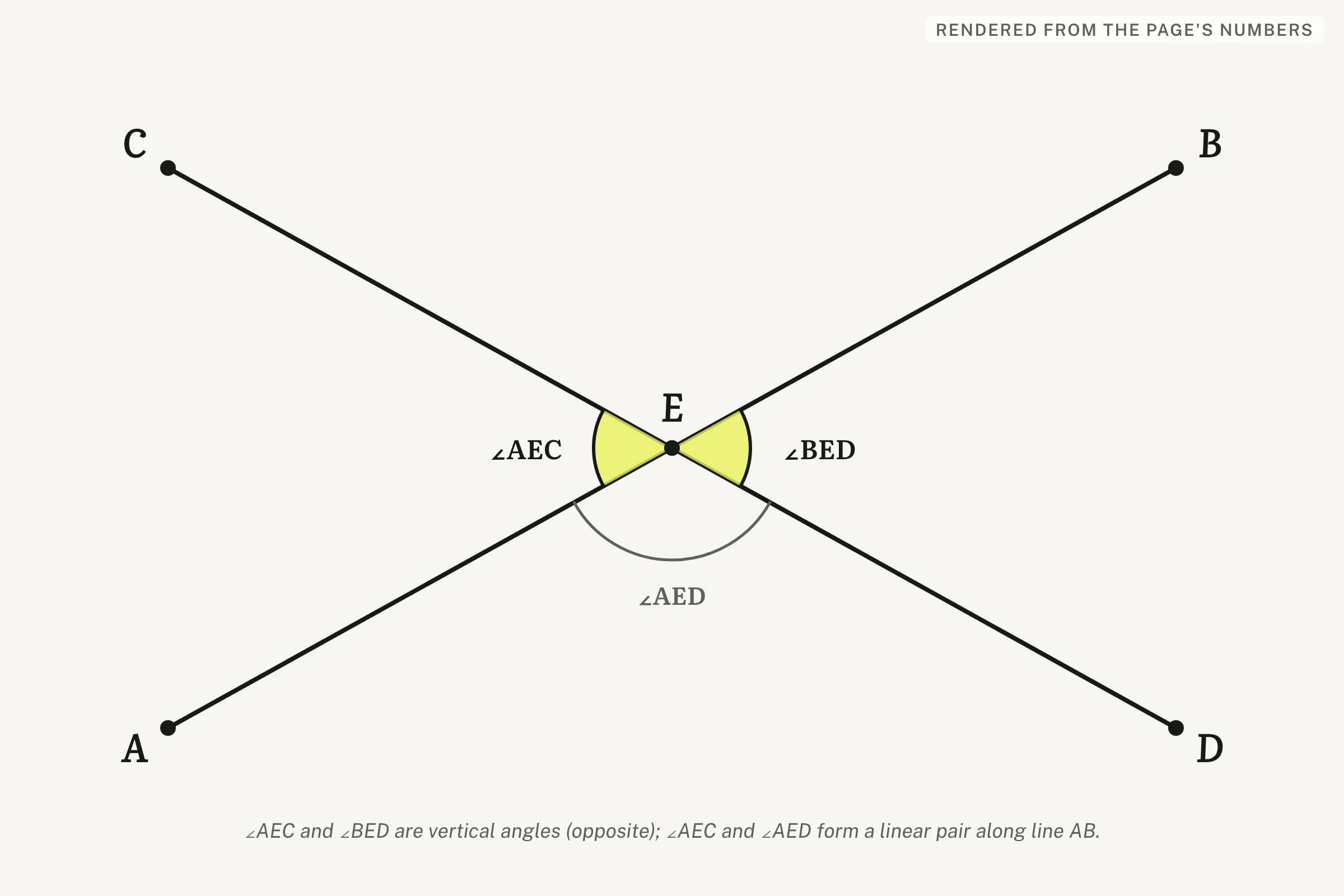
Given: Lines and intersect at point . Prove:.
DiagramText equivalent: two lines cross at E, forming four angles. ∠AEC and ∠BED sit directly opposite (vertical angles); ∠AEC and ∠AED sit side by side along line AB (a linear pair).
Proof 1 - vertical angles are congruent
Statements
Reasons
1. Lines and intersect at
Given
2. , form a linear pair; , form a linear pair
Definition of linear pair
3. ;
Linear Pair Postulate
4.
Substitution Property of Equality
5.
Subtraction Property of Equality
6.
Definition of congruent angles
Linear pair theorem: two angles in a linear pair are supplementary
Proof 1 cites the Linear Pair Postulate in row 3. Some textbooks accept that statement as a postulate; others prove it as a theorem from the Angle Addition Postulate, and the proof takes five rows after the Given.
Linear pair theorem - two angles in a linear pair are supplementary
Statements
Reasons
1. and form a linear pair
Given
2. The outer sides of and are opposite rays
Definition of linear pair
3. equals the measure of the straight angle those rays form
Angle Addition Postulate
4. The straight angle measures
Definition of a straight angle
5.
Substitution Property of Equality
6. and are supplementary
Definition of supplementary angles
Vertical angles theorem: the statement, and a numeric check
The Vertical Angles Theorem says that when two lines intersect, each pair of opposite angles is congruent. Proof 1 above is its proof, so once your course has proved it, a later proof cites it as a single reason instead of repeating the six rows.
Numeric check. and are vertical angles, so their measures are equal: , which gives and . Both angles measure : and .
Proof 2 - congruent triangles by SAS, finished with CPCTC
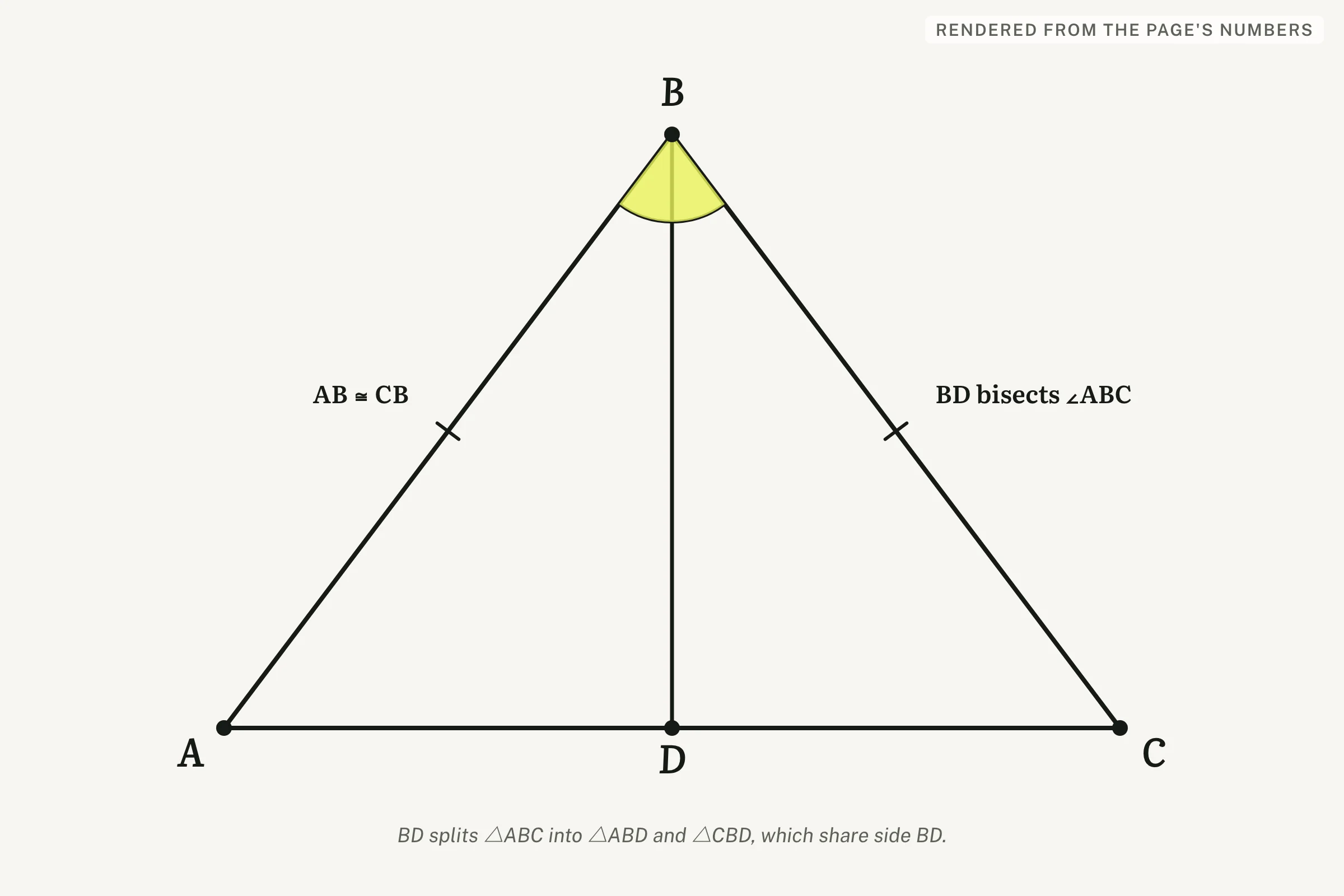
Given:; bisects . Prove:.
DiagramText equivalent: triangle , at top; segment drops to point on , splitting into two triangles, and , sharing side .
Proof 2 - SAS, finished with CPCTC
Statements
Reasons
1.
Given
2. bisects
Given
3.
Definition of angle bisector
4.
Reflexive Property
5.
SAS Postulate (steps 1, 3, 4)
6.
CPCTC
CPCTC - Corresponding Parts of Congruent Triangles are Congruent - only fires after triangle congruence is proved; citing it before step 5 is the most common reason-column error graders flag.
Proof 3 - parallel lines cut by a transversal
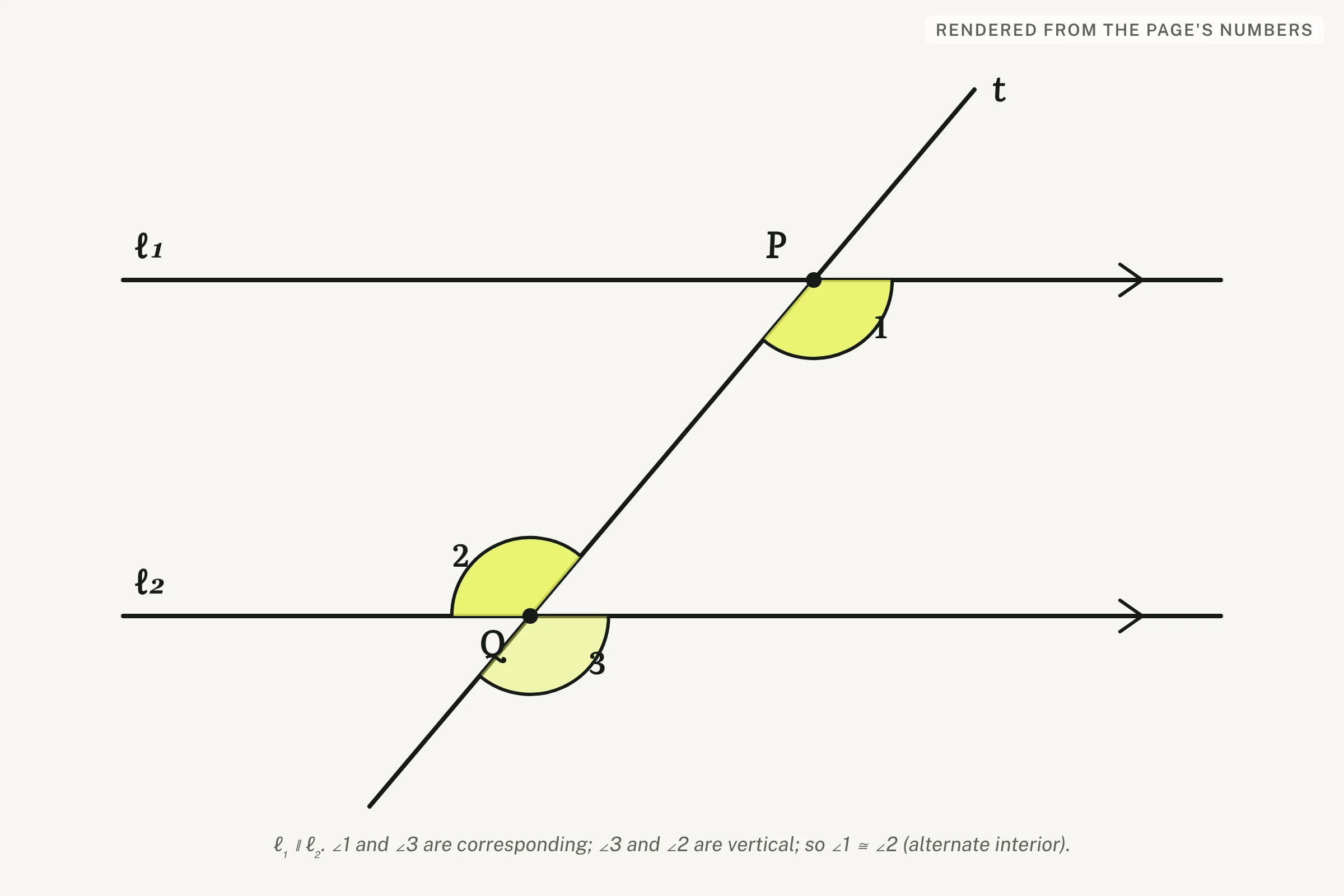
Given:, transversal crosses at and at . Prove: (alternate interior angles).
DiagramText equivalent: two horizontal parallel lines, on top and below, crossed by one diagonal line . At (top), is the interior angle on the lower-right. At (bottom), is the angle in the same lower-right position (corresponding to ), and is the interior angle on the upper-left - vertical to , and on the opposite side of from .
Proof 3 - parallel lines and transversals
Statements
Reasons
1.
Given
2.
Corresponding Angles Postulate
3.
Vertical Angles Theorem
4.
Transitive Property of Congruence
Proof 4 - a segment/angle bisector proof
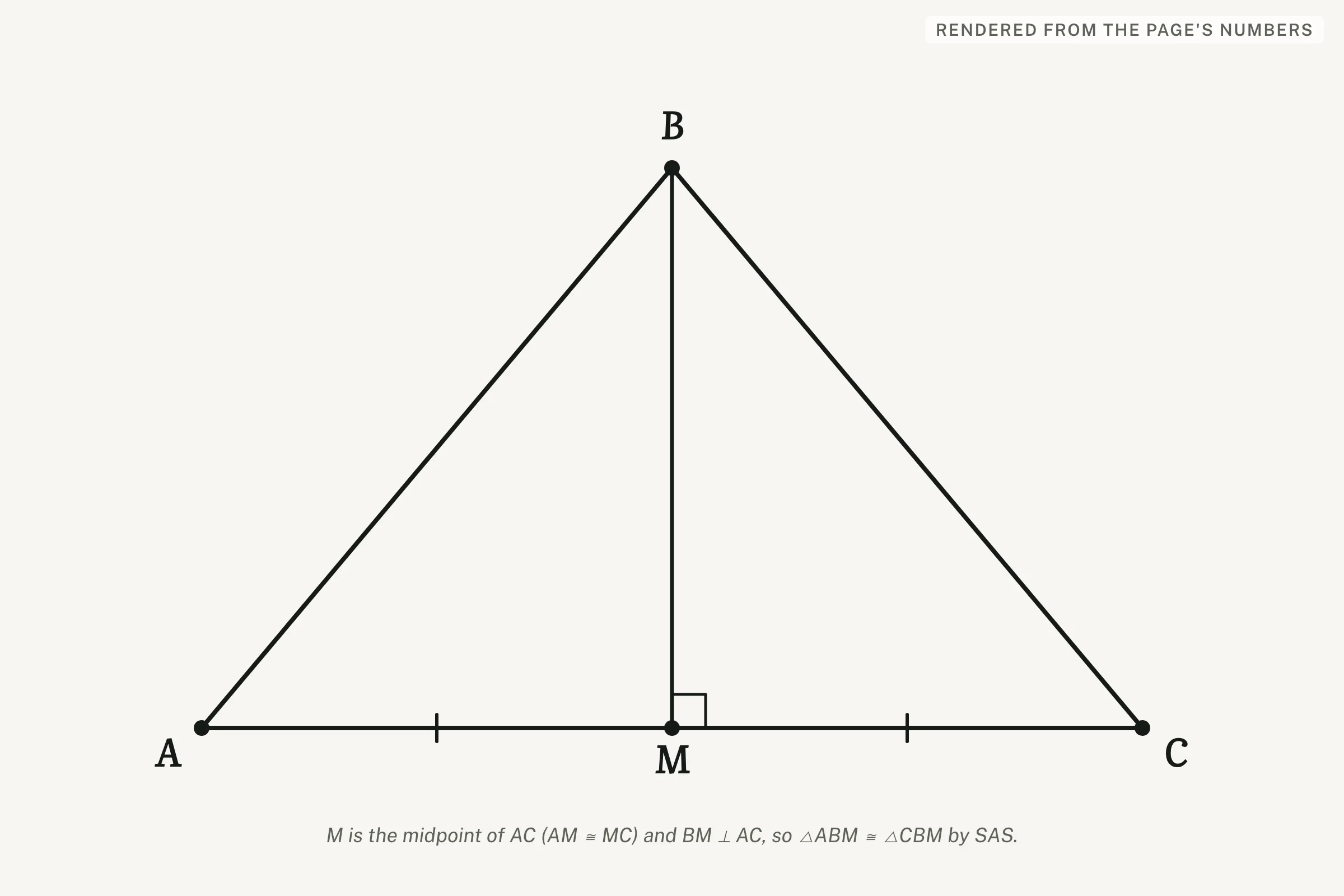
Given: is the midpoint of ; . Prove:.
DiagramText equivalent: triangle with base horizontal. Point sits at the exact midpoint of ; segment rises from to vertex , meeting at a right angle (marked with a small square).
Proof 4 - a perpendicular bisector proof
Statements
Reasons
1. is the midpoint of
Given
2.
Definition of midpoint
3.
Given
4. , are right angles
Definition of perpendicular lines
5.
All right angles are congruent
6.
Reflexive Property
7.
SAS Postulate (steps 2, 5, 6)
8.
CPCTC
The reason bank: every postulate, theorem and definition you are allowed to cite
Every reason above traces to Euclid's original postulates, filtered to the set most courses allow - SSS, SAS, ASA, AAS and HL cover triangle congruence; the rest cover angles, segments and logic. Wording matches common textbook phrasing, consistent with open references like K12 LibreTexts.
The reason bank, grouped by what it lets you conclude
Converse of the Corresponding Angles Postulate; converse of the Alternate Interior Angles Theorem
An angle is a right angle
Definition of perpendicular lines
Two triangles are congruent
SSS, SAS, ASA, AAS or HL
A relationship carries across steps
Substitution Property; Transitive Property
An equation stays true after the same change to both sides
Addition or Subtraction Property of Equality
A statement reads the same in reverse
Symmetric Property
A geometric fact by definition
Linear pair, perpendicular lines, congruent figures
A blank template to start your own proof
Blank two-column proof template
Statements
Reasons
1.
1.
2.
2.
3.
3.
4.
4.
5.
5.
Given: _____ Prove: _____ - fill the Given/Prove line first; every row after should trace back to it plus a reason from the bank above. A proof set due tonight that you would rather hand over whole can go in as a geometry assignment for us to complete, solved in this same format.
§ 02
Missing statement or missing reason: filling the gap in a two-column proof
A missing-statement or missing-reason item hands you a finished proof with one cell blank, and the fastest route is to read the rows on both sides of the gap. A missing statement is whatever the next reason needs in order to work; a missing reason is the one entry in the reason bank that turns the rows above into this row. Three worked items follow, one of each kind.
Missing reason: a linear pair adds to 180°
Find the missing reason
Statements
Reasons
1. and form a linear pair
Given
2.
?
Answer: Linear Pair Postulate (Linear Pair Theorem in a textbook that proves it). Row 1 names a linear pair and row 2 states the sum of its angles, so the reason has to be the one bank entry that links those two facts.
Missing statement: what the definition of midpoint gives you
Find the missing statement
Statements
Reasons
1. is the midpoint of
Given
2. ?
Definition of midpoint
Answer:. The reason column says "definition of midpoint", and that definition gives exactly one fact: a midpoint splits a segment into two congruent segments.
Missing step: the row an SAS proof skipped
Find the missing row
Statements
Reasons
1.
Given
2. bisects
Given
3. ?
?
4.
Reflexive Property
5.
SAS Postulate (steps 1, 3, 4)
Answer: row 3 is , by the definition of angle bisector. SAS needs two sides and the angle between them; the sides are rows 1 and 4, so the missing row has to supply that angle, and the bisector in row 2 is what makes the two angles congruent.
§ 03
Build the proof one row at a time
Reading a finished proof rarely builds the skill of producing one - choosing the right reason from several plausible ones is the actual difficulty. The revealer below rebuilds Proof 1 row by row, with the reasons a student might guess before the right one is confirmed.
Reveal the next statement
Each row's reason stays hidden until you commit to a guess, or until you reveal every reason at once; without JavaScript, the full walkthrough below shows every row open.
See which reason justifies it
Interactive helper
Proof revealer: vertical angles, row by row
How it works online: guess the reason, then reveal it; the reason list is filtered to plausible candidates, not the full bank, so the choice is real.
Full proof, every reason shown
Proof revealer - full static walkthrough
Step
Statement
Plausible reasons
Correct reason
1
Lines , intersect at
Given / Definition of intersecting lines
Given
2
, form a linear pair
Definition of linear pair / Definition of adjacent angles
Definition of linear pair
3
Linear Pair Postulate / Angle Addition Postulate
Linear Pair Postulate
4
Substitution Property / Transitive Property
Substitution Property
5
Subtraction Property / Reflexive Property
Subtraction Property of Equality
6
Definition of congruent angles / CPCTC
Definition of congruent angles
Scroll the table sideways to see every column.
Why the order cannot be shuffled
Step 5 subtracts from both sides of step 4's equation - swap them and there's nothing yet to subtract from. A geometry solver that outputs only the final claim skips exactly this ordering skill.
§ 04
Geometry help by problem type
One worked problem per type below, each with its diagram - short workings, since the proofs above already carry the depth. This is help with geometry sorted by category, not one generic example.
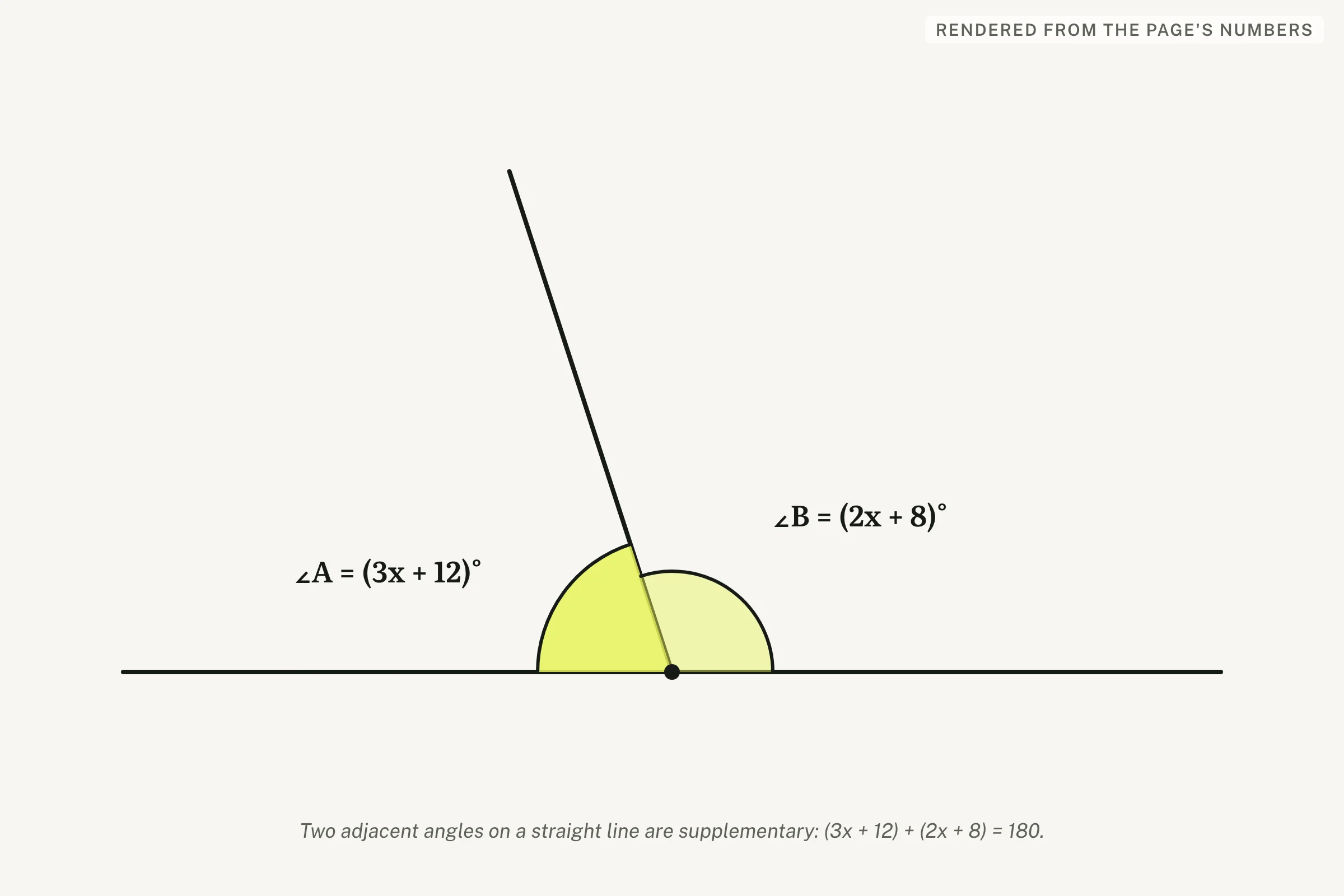
Problem. and are supplementary: , . Find and each angle.
DiagramText equivalent: a straight line split by one ray into and side by side.
. , (check: ).
Triangles: congruence, similarity, special right triangles
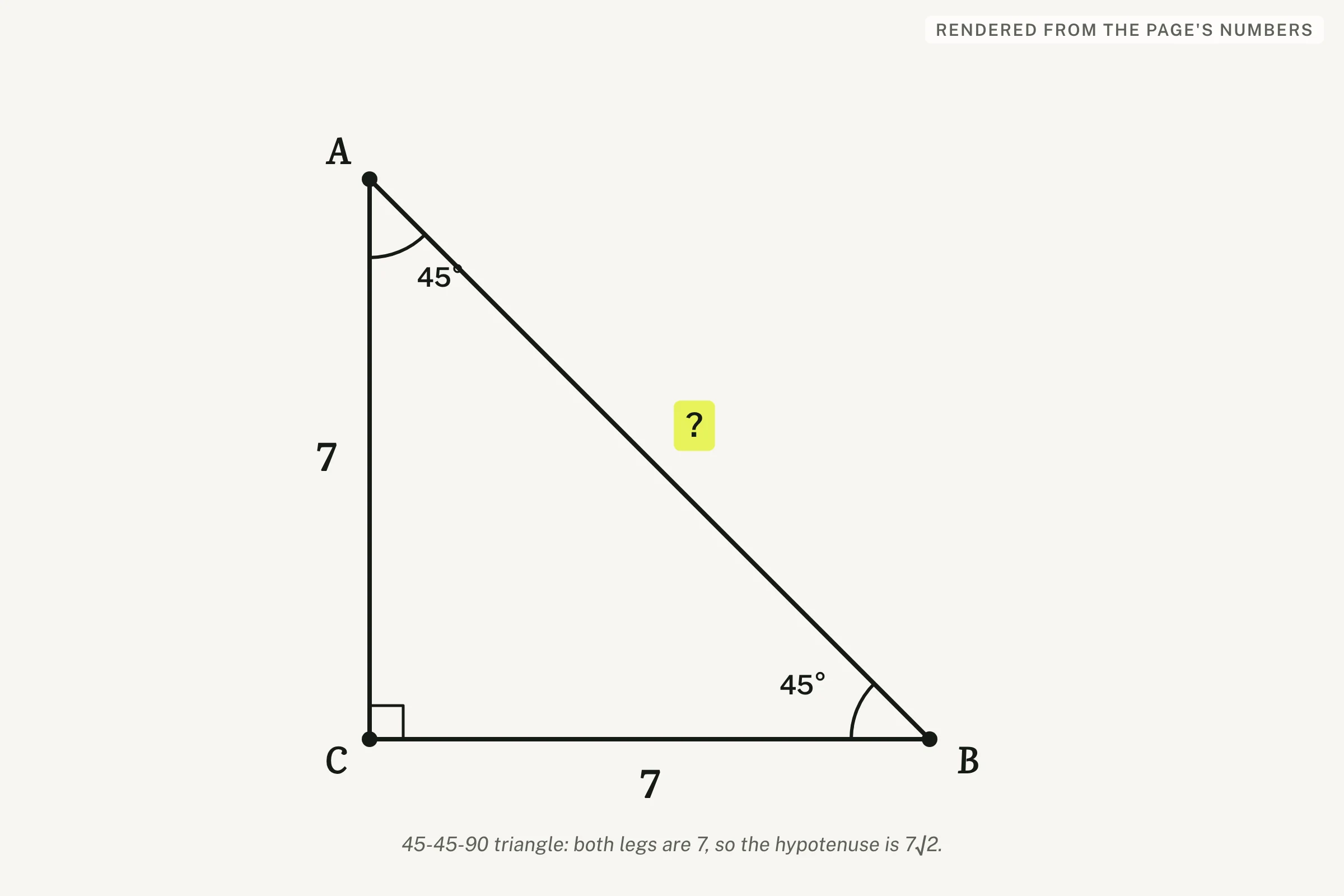
Problem. A 45-45-90 triangle has a leg of length 7. Find the hypotenuse.
DiagramText equivalent: right angle at bottom, both legs labeled 7, base angles marked 45°, hypotenuse marked with a question mark.
Hypotenuse .
Similar triangles are a proportion problem: every side of the image equals the matching original side times one scale factor, so the pairs of side lengths form a direct variation with constant k. A triangle with sides 4, 5 and 6 scaled by has sides 12, 15 and 18, and each ratio, , and , equals 3.
Circles: arcs, chords, inscribed angles
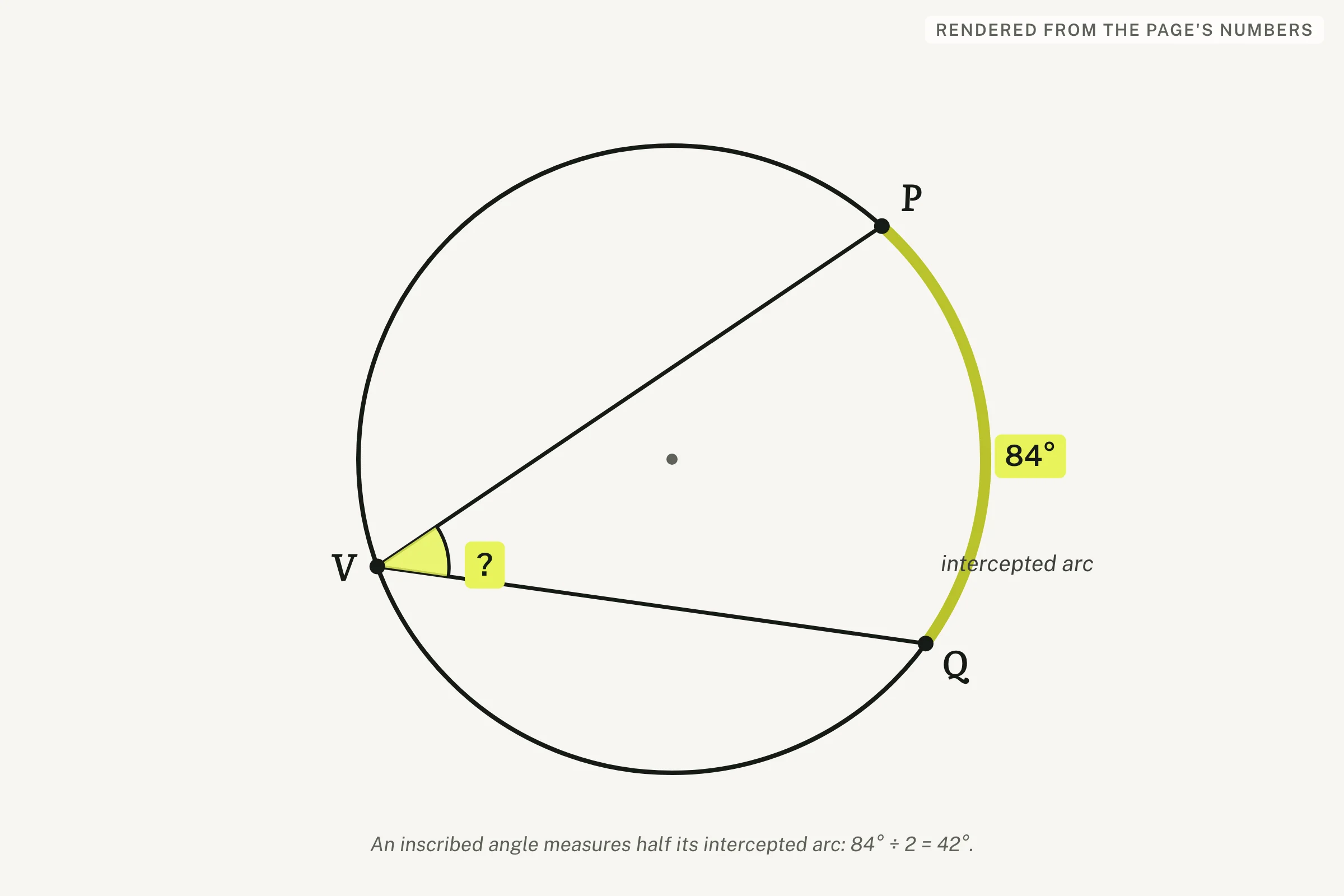
Problem. An inscribed angle intercepts an arc of 84°. Find the inscribed angle.
DiagramText equivalent: an angle drawn from a point on the circle to two other points on it; the far arc between those points is marked 84°.
Inscribed angle intercepted arc .
Area, surface area and volume
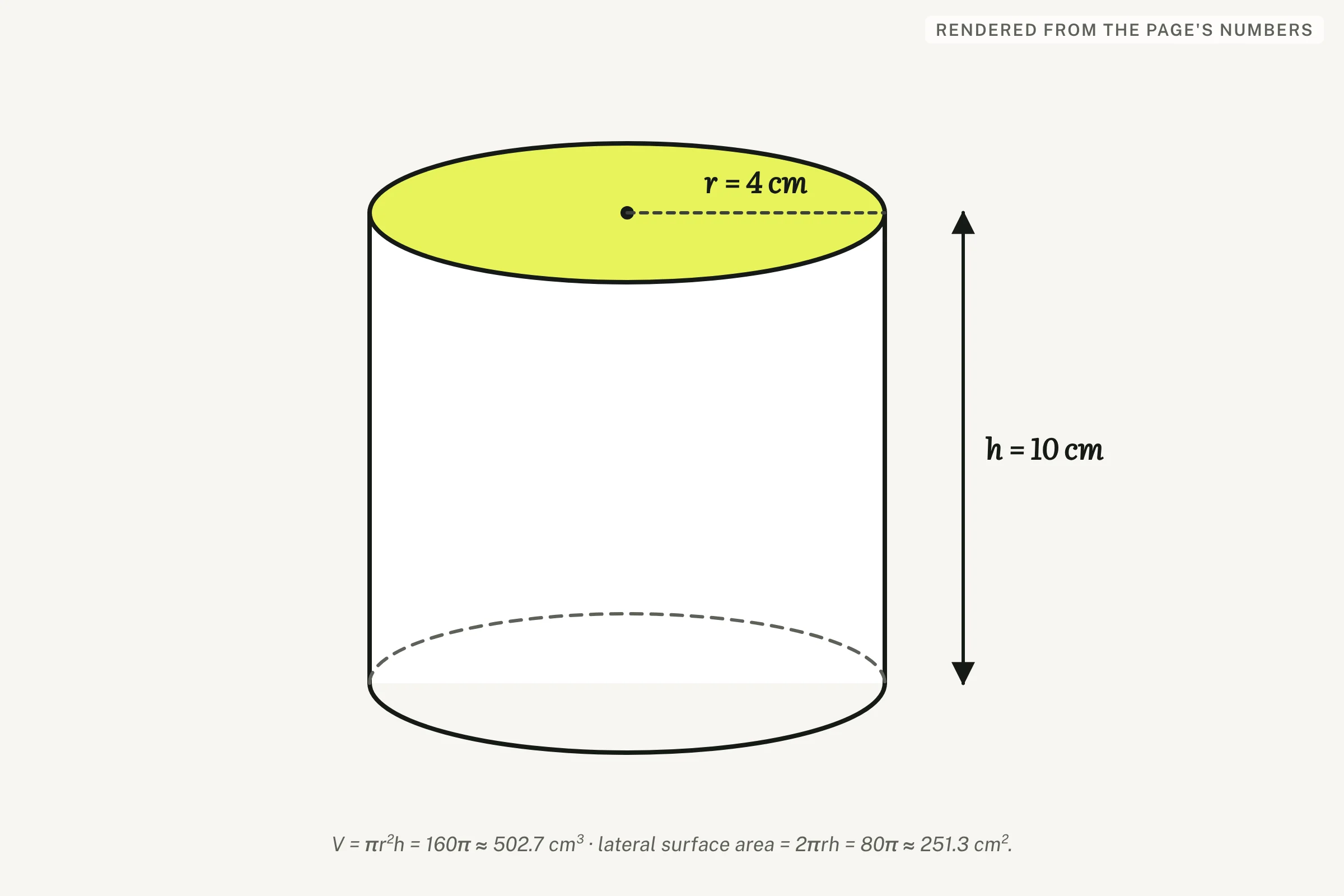
Problem. A cylinder has radius 4 cm and height 10 cm. Find its volume and lateral surface area.
DiagramText equivalent: upright cylinder, top circle radius 4 cm, side height 10 cm.
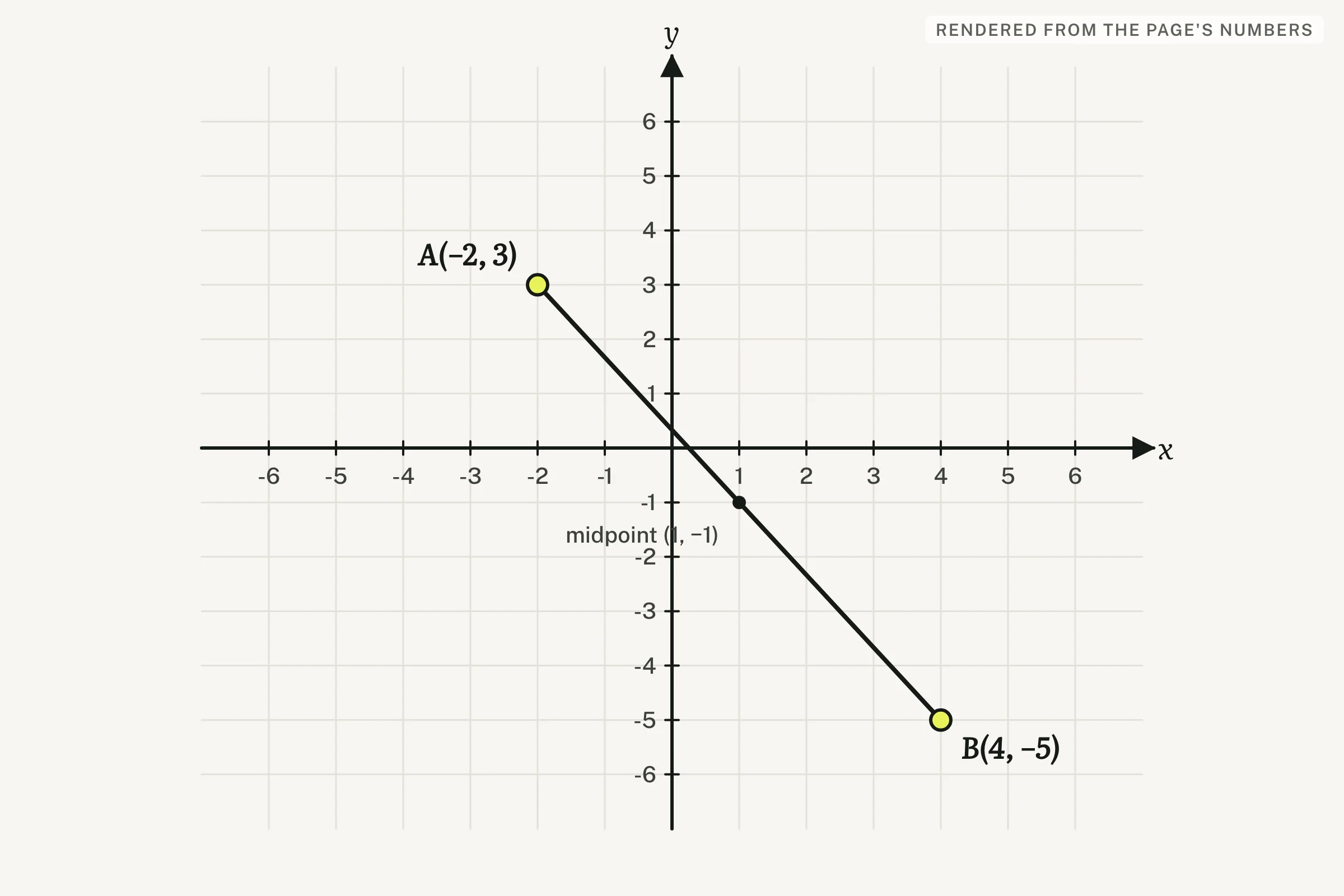
Problem. Given and , find the distance, midpoint and slope of .
DiagramText equivalent: point in quadrant II, point in quadrant IV, joined by a straight segment.
Distance . Midpoint . Slope . The same distance-formula and vector-component skills carry into physics problems that ask for displacement rather than a plotted segment.
§ 05
Geometry solvers: what they do well and where they break
"Geometry solver," "geometry problem solver," "geometry ai solver" and "ai geometry solver" together carry more volume than any other term on this page - a real intent this section answers honestly rather than dodges. The same spatial reasoning shows up outside math class too: molecular-geometry problems in chemistry and biology homework help ask for bond angles the same way a geometry proof asks for a congruence, and a course that wants a coded geometric algorithm instead of a proof goes to the programming desk.
Photo solvers and diagram misreads
Photo-based solvers like Photomath and Mathway read a diagram's marks - tick marks, arcs, the small right-angle square - through image recognition; a mark just outside the crop, or a smudged photo, is routinely missed. A geometry math solver builds its answer on a mark it never saw. For checking a construction rather than solving it, free tools like GeoGebra or Desmos Geometry beat another solved example.
Why a solver cannot produce a valid reason column
Solver output vs. a graded reason column (composite sample written by GradeDraft, Proof 1)
Before (solver output, given Proof 1 as a photo)
"∠AEC ≅ ∠BED, because vertical angles are equal."
After (graded two-column proof)
The same conclusion, built from the reason bank one citable step at a time: Definition of linear pair → Linear Pair Postulate → Substitution Property of Equality → Subtraction Property of Equality → Definition of congruent angles.
What changed
The solver states a true conclusion but collapses four separate reason-column entries into a single sentence.
A grader reading the reason column, not just the claim, marks that incomplete - the Linear Pair Postulate and Subtraction Property each need their own row.
"Vertical angles are equal" is the theorem the proof is built to establish, not a citable reason within it - the real answer to best ai for geometry proofs: none show their reasons the way a grader needs.
Can ChatGPT solve geometry problems?
Chatbots handle the algebra inside a proof fine but often invent a plausible-sounding reason - "by the Angle Sum Theorem" - when the real justification is more specific, like the Linear Pair Postulate. The fix: check every reason against the bank above, not just the math.
Send the assignment or a photo of the problems and your deadline - we quote a fixed price before any proof is touched.
Geometry work is graded partly on notation, so diagrams arrive marked the way your textbook marks them - tick marks, arcs, right-angle squares matching your class's convention.
Turnaround
Standard turnaround runs 3 days down to 24 hours; a same-night set is a rush order at a 40% surcharge. Problem sets price from $25 per problem after review.
§ 07
Geometry tutoring vs solved solutions
Geometry tutor is a large term on this page, and GradeDraft sells solved proofs and problem sets first, live tutoring second - both real, staffed services.
What a live geometry session is good for
When the class runs the full term and the gap is a skill - reason selection, not one deadline - weekly sessions with geometry tutors build it faster than a solved set ever will.
Online geometry tutors: format and cost
A 50-minute session over screen share, working that week's proofs, at $45 per hour standard or $55 at AP or Regents level. Search geometry tutors online and most results are directories, not staffed sessions; ours is a direct booking.
When the set just needs finishing
One deadline, one assignment, no time left to build the skill first - that's when a solved set, not a tutoring package, is right.
Brief received
Reference GD-000000
A priced quote comes back to your email. Replies within 2 hours, 8 am–11 pm ET, 7 days a week.
Replies within 2 hours, 8 am–11 pm ET, 7 days a week
Briefp. 1
A sample paragraph before you pay, on every order
— 1 —
Included
Turnitin originality report included
USD
Problem setfrom $25
Programming taskfrom $79
Live tutoring$45
Revisionsp. 2
Free revisions for 14 days (30 days for dissertation chapters and capstones)
FAQ
More questions about proofs and geometry apps
Replies within 2 hours, 8 am–11 pm ET, 7 days a week
“8 questions
01
What is a two-column proof in geometry?
A format with two columns side by side: statements on the left, in logical order, and the reason justifying each one on the right. Every statement must follow from the Given facts, an earlier statement, or a citable postulate, theorem or definition - never the diagram alone.
02
How do you get an A in geometry?
Match every statement to its exact reason, not a close-sounding one - graders distinguish "vertical angles are congruent" from "corresponding angles are congruent." Redo missed proofs against the reason bank, not just the final answer.
03
How do you tutor someone in geometry?
Start from the reason bank, not the proof - have them name which reason applies before writing the statement, since guessing is the actual skill gap in students who "know the answer" but can't justify it.
04
What's the difference between a two-column proof and a paragraph proof?
Same logic, different format: a two-column proof lists statements and reasons in a table; a paragraph proof writes the same chain as connected sentences. Most courses teach two-column first since a missing reason is obvious in a table.
05
Do I need to memorize every postulate and theorem?
Most graded proofs draw from a short, repeated set - the reason bank above covers what shows up in nearly every course. Memorize the names precisely; "close enough" still costs marks on a strict rubric.
06
Can a geometry solver check my proof instead of just the answer?
Not reliably. Solvers return a final value or claim, not a graded reason column - the proof revealer above shows the reasoning step a solver skips.
07
What if my diagram doesn't match the one in the assignment?
Send both versions when you request help; a redrawn diagram that shifts a mark's position can change which reason applies, and we match diagrams to your textbook's conventions.
08
Is geometry harder than algebra?
Different skill, not necessarily harder: algebra rewards symbol manipulation, geometry rewards justified reasoning - strength in one doesn't guarantee the other until the reason-bank habit clicks.