To explain economic resources simply: they are the inputs an economy uses to produce goods and services — land, labor, capital, and entrepreneurship, together called the factors of production. Money is not one of them; it only buys resources. Every economic system, market, command, or mixed, exists to answer the same three questions: what to produce, how to produce it, and for whom to produce it.
explain economic resources
What Are Economic Resources? Factors of Production and the Three Basic Economic Questions
On this page
- Economic resources, defined
- The four factors of production, with examples of each
- Why money is not an economic resource
- Scarcity: why resources being limited is the whole subject
- The three basic economic questions: what, how, and for whom
- Resources in a market economy are allocated through individual decision-making
- Resource market vs product market: the circular flow
- Market, command and mixed economies compared
- Macroeconomics: the study of the economy as a whole
- Macroeconomic equilibrium in one diagram
- The Chapter 1 questions your instructor will actually ask
- If the whole econ problem set is due
Economic resources, defined
The one-sentence definition
Economic resources are the inputs — land, labor, capital, and entrepreneurship — that a society combines to produce the goods and services it wants. If a worksheet instruction says to explain economic resources, this is the one-sentence answer it wants, and it's the same economic resources definition used across US principles-of-economics courses: resources are scarce, they are inputs rather than outputs, and an economy's whole productive capacity comes from how well it combines them.
Economic resources vs factors of production vs inputs - same thing, three names
Economic resources, factors of production, and inputs are the same four items under three labels, tracking whichever textbook a course assigns. McConnell, Brue and Flynn's Economics calls them "resources." Mankiw's Principles of Economics and OpenStax's Principles of Economics use "factors of production." Quick-reference sites like tutor2u, Outlier.org, Study.com, and Vaia shorten it to "inputs." None of that changes the economic resources meaning — what are economic resources, or what economic resources are, in any phrasing: land, labor, capital, entrepreneurship.
Which of the following is not considered an economic resource
Money, stocks, and bonds are not considered economic resources — they are financial capital, meaning claims on resources, not resources themselves. This is the most common multiple-choice trap in the chapter: wrong answers are almost always a dollar amount, a stock, or a bond, dropped next to genuine resources like farmland. What is an economic resource comes down to one test: does it directly help produce a good or service? An oil field does. A $20 bill does not — it only buys access to the field, the rig, and the workers who run it. If the chapter worksheet itself is the problem, you can send it as a do my assignment order and get every answer explained in these terms.
The four factors of production, with examples of each
Every good or service traces back to some combination of these four factors of production. Real economic resources examples make the categories concrete fast, and each factor earns a different payment — the column most Chapter 1 reviews skip. That's what economic resources define in practice: land, labor, capital and entrepreneurship, not money.
Land: everything the earth supplies
Land covers every natural resource used in production, not just the ground itself: farmland, forests, water, oil, mineral deposits, and broadcast airwaves all count. Three US examples: Iowa cropland, Permian Basin natural gas, Pacific Northwest timber. Land earns rent — the payment to whoever controls it.
Labor: human effort, physical and mental
Labor is human effort applied to production, physical or mental, skilled or unskilled. Three US examples: a nurse's hospital shift, a developer's coding hours, and a line cook's dinner-rush shift. Labor earns wages — the broadest category, covering every paycheck from minimum wage to a surgeon's salary.
Capital: tools, machines, buildings - not money
Capital means the human-made tools used to produce other goods: machinery, buildings, trucks, computers, ovens. It does not mean money — a checking-account balance cannot bake bread, so economists reserve "capital" for the equipment itself. Three US examples: a delivery truck, a Michigan auto assembly line, a bakery's commercial oven. Capital earns interest — the return to whoever supplied the funds that bought it.
More labor and capital examples, and the edge cases
Most textbook items test whether you can split one job into its factors. The rule: a person's time and effort is labor, a made thing that person works with is capital, and skills count under labor rather than as a fifth factor.
| Example | Counts as | Why |
|---|---|---|
| An electrician wiring a new house | Labor | Skilled physical effort |
| A pharmacist checking prescriptions | Labor | Skilled mental effort |
| A warehouse picker's shift | Labor | Physical effort |
| A call-center agent's workday | Labor | Effort delivered as a service |
| A farmhand's harvest week | Labor | Seasonal physical effort |
| An accountant's hours on tax returns | Labor | Mental effort |
| A tractor on a Kansas wheat farm | Capital | A made machine that produces crops |
| A hospital's MRI scanner | Capital | Equipment that produces a medical service |
| A restaurant's walk-in refrigerator | Capital | Equipment used to prepare meals |
| A warehouse forklift | Capital | A machine that moves goods |
| A dentist's drill | Capital | A tool used to produce a service |
| A cell tower | Capital | A made structure that produces phone service |
| Edge case: a delivery truck and its driver | Truck: capital. Driver's hours: labor | One delivery uses two factors, counted separately |
| Edge case: a laptop and the coder's hours | Laptop: capital. Coding hours: labor | The tool and the effort that uses it are different inputs |
| Edge case: human capital (skills, training) | Labor | Skills raise the quality of labor and are counted under labor, which is why a degree is a credential, not a resource |
Entrepreneurship: the resource that combines the other three
Entrepreneurship, sometimes labeled entrepreneurial ability, organizes land, labor and capital into a business, while accepting the risk it might fail. Three US examples: a food-truck founder financing a launch, a farmer choosing this season's crops, and a manufacturer redesigning a line to cut waste. Entrepreneurship earns profit — what's left after rent, wages and interest are paid, and the only payment that can go negative.
Three or four economic resources? Why the count differs by textbook
Some courses list three economic resources — land, labor, capital — folding entrepreneurship into labor. Most current US principles texts, including Mankiw and OpenStax, list four, because entrepreneurship bears risk wages and rent don't, and decides how the other three combine. If your course says three, it's just an older framing. Check which count your rubric uses before answering a total-based multiple-choice item.
| Factor | Definition | Three US examples | Payment earned |
|---|---|---|---|
| Land | Natural resources used in production | Iowa cropland · Permian Basin natural gas · Pacific Northwest timber | Rent |
| Labor | Human effort, physical or mental | A nurse's hospital shift · a developer's coding hours · a line cook's dinner-rush shift | Wages |
| Capital | Human-made tools and equipment | A delivery truck · a Michigan auto assembly line · a bakery's commercial oven | Interest |
| Entrepreneurship | Combines the other three, bears the risk | A food-truck founder · a farmer's planting decision · a manufacturer redesigning a line | Profit |
Scroll the table sideways to see every column.
Why money is not an economic resource
Is money an economic resource? No: it buys resources and produces nothing
Economists do not include money as an economic resource because money does not produce anything by itself — it only lets you buy the land, labor, capital, or entrepreneurship that do the producing. A hundred-dollar bill can't plant a field or run a machine; it can only buy access to something that can. Production needs an actual input, and money is a medium of exchange, not an input.
Are stocks an economic resource?
No: a share of stock is financial capital, an ownership claim on a firm, while the firm's machines and buildings are the real capital. Buying a share on an exchange moves ownership from one investor to another and creates no new input. A newly issued share raises money that the firm may then spend on real capital, and only that spending adds a resource. Bonds work the same way: a bond is a claim to repayment, not a tool, which is why the savings bond in the sorter above is a trap.
Financial capital vs real capital
"Capital" means two different things depending on the sentence. Real capital — the economic-resource kind — is physical equipment: a truck, a factory, a laptop. Financial capital is the money, stocks, and bonds used to buy that equipment. A business that raises $50,000 in financial capital hasn't produced anything yet; only once it buys the truck does it become real capital.
Scarcity: why resources being limited is the whole subject
Limited resources, unlimited wants
Scarcity is the condition of having limited resources against unlimited wants — the reason economics exists as a subject. If land, labor, capital and entrepreneurship were unlimited, every want could be met. Because resources are finite, every economy has to choose, and every choice has a cost.
Opportunity cost: the cost of the road not taken
Opportunity cost is the value of the next-best alternative you give up when you choose one use of a scarce resource over another. Suppose a state government chooses highway repair over university funding for the same budget; the opportunity cost is the funding it didn't choose, not the dollars themselves. Every decision under scarcity carries an opportunity cost, whether the decision-maker is a household, a business, or a government.
Where the production possibilities frontier comes in
The production possibilities frontier graphs the maximum combinations of two goods an economy can produce with current resources and technology. A point on the frontier is efficient; a point inside it means idle resources; a point outside it isn't reachable without more resources or better technology. Producing more of one good along the frontier always means less of the other — opportunity cost drawn at the scale of a whole economy. The bowed-out shape most PPFs take reflects increasing opportunity cost, the same curve-sketching territory as the three forms of a quadratic.
The three basic economic questions: what, how, and for whom
What to produce
The first question is what to produce: given limited resources, which goods get made, and how much? A market economy answers through consumer demand; a command economy answers through central planning.
How to produce it
The second question is how to produce it: what combination of resources and technology gets used? A market economy leaves this to firms competing on cost; a command economy sets the method.
For whom to produce it
The third question is for whom to produce it: once goods exist, who gets them? A market economy allocates through prices; a command economy allocates through rationing or government priority.
Why every economic system is just an answer to these three
Every economic system that has existed, from a hunter-gatherer band to a modern mixed economy, is a set of institutions for answering what to produce, how to produce, and for whom to produce. The 3 questions in economics — sometimes phrased as economics 3 questions — don't change; only the mechanism does. These economics questions repeat across every later unit, which is why comparing market, command, and mixed economies next is a comparison of three answers to the same three questions.
| Question | What it decides | Market answer | Command answer |
|---|---|---|---|
| What to produce | Which goods and services, and how much | Consumer demand and price signals | Central planning targets |
| How to produce it | The mix of resources and technology used | Firms choose the lowest-cost method | The plan specifies the method |
| For whom to produce it | Who receives the output | Whoever can pay the market price | Rationing or government priority |
Scroll the table sideways to see every column.
Resources in a market economy are allocated through individual decision-making
Filling in the blank: the word is "market"
The word that completes the sentence is "market": resources in a market economy are allocated through individual decision-making. In a market economy, no central authority decides who gets the corn crop or a factory's output; millions of separate decisions by buyers and sellers, each acting in their own interest, add up to an allocation nobody planned in advance.
Prices as the signal
Prices turn that individual decision-making into something coherent. Adam Smith's phrase for this, the invisible hand, describes how a system with no central planner still allocates resources efficiently: a rising price tells producers to make more and buyers to use less, automatically.
Who actually gets scarce resources - and who decides
In a market system, scarce resources go to whoever is willing and able to pay the market price — a decision made by millions of buyers and sellers, not a single planning office. Nobody "decides" the way a government agency decides; the outcome is the sum of every individual choice, coordinated through price.
Resource market vs product market: the circular flow
The resource market is where households sell the four factors of production to firms; the product market is where firms sell finished goods and services back to households. The circular flow model joins the two into one loop: money moves one way around it, while resources and products move the other way.
| Market | Who sells | Who buys | What changes hands | What flows back |
|---|---|---|---|---|
| Resource (factor) market | Households | Firms | Land, labor, capital and entrepreneurship | Rent, wages, interest and profit: household income |
| Product market | Firms | Households | Goods and services | Consumer spending: firms' revenue |
Scroll the table sideways to see every column.
One trip around the loop takes four steps:
- Households own the resources and sell them to firms in the resource market.
- Firms pay rent, wages, interest and profit, and those payments become household income.
- Firms combine the resources into goods and services and sell them to households in the product market.
- Households spend their income on those goods and services; the spending becomes firms' revenue, which pays for the next round of resources.
Market, command and mixed economies compared
Market economy
A market economy answers all three basic economic questions through private ownership and prices, with government playing a minimal role. Buyers and sellers make the decisions; nobody centrally plans output.
Command economy
A command economy answers the three questions through government ownership and central planning. A planning body sets production targets, decides methods, and controls distribution, and prices play little or no allocating role.
Mixed economy - where the US actually sits
A mixed economy combines private markets with government intervention — regulation, public goods, some public ownership — on a market foundation. The United States is a mixed economy: markets set most production and prices, but government supplies defense, regulates industries like banking, and redistributes income through Social Security.
| Market economy | Command economy | Mixed economy | |
|---|---|---|---|
| Who owns the resources | Private individuals and firms | The government | Mostly private, some public ownership |
| Who answers the three questions | Individual buyers and sellers | Central government planners | Markets, with government regulation |
| How prices are set | Supply and demand | Set or controlled by government | Mostly supply and demand, regulated in places |
| Real example | Hong Kong's low-intervention market | Historic Soviet Union central planning | The United States |
Scroll the table sideways to see every column.
Macroeconomics: the study of the economy as a whole
Macro vs micro in one line each
Macroeconomics studies the economy as a whole; microeconomics studies individual households, firms, and markets one at a time. A macroeconomics question asks what's happening to the national unemployment rate; a microeconomics question asks what's happening to the price of one company's product.
What macroeconomics actually examines (output, employment, price level, growth)
Macroeconomics is the study of the economy as a whole — total output (GDP), overall employment, the general price level, and long-run growth, rather than the choices of one household or firm. AP Macroeconomics, the College Board course most US high schoolers meet this in, builds its syllabus around these four measures plus fiscal and monetary policy.
Common phrasings of this exam item
This question shows up under near-identical phrasings across textbooks and quiz banks: "macroeconomics is a study of," "macroeconomics is the study of," and "the study of the economy as a whole" — sometimes still carrying its original number, as in "4. the study of the economy as a whole." All want one answer: macroeconomics.
Macroeconomic equilibrium in one diagram
Where AD meets AS
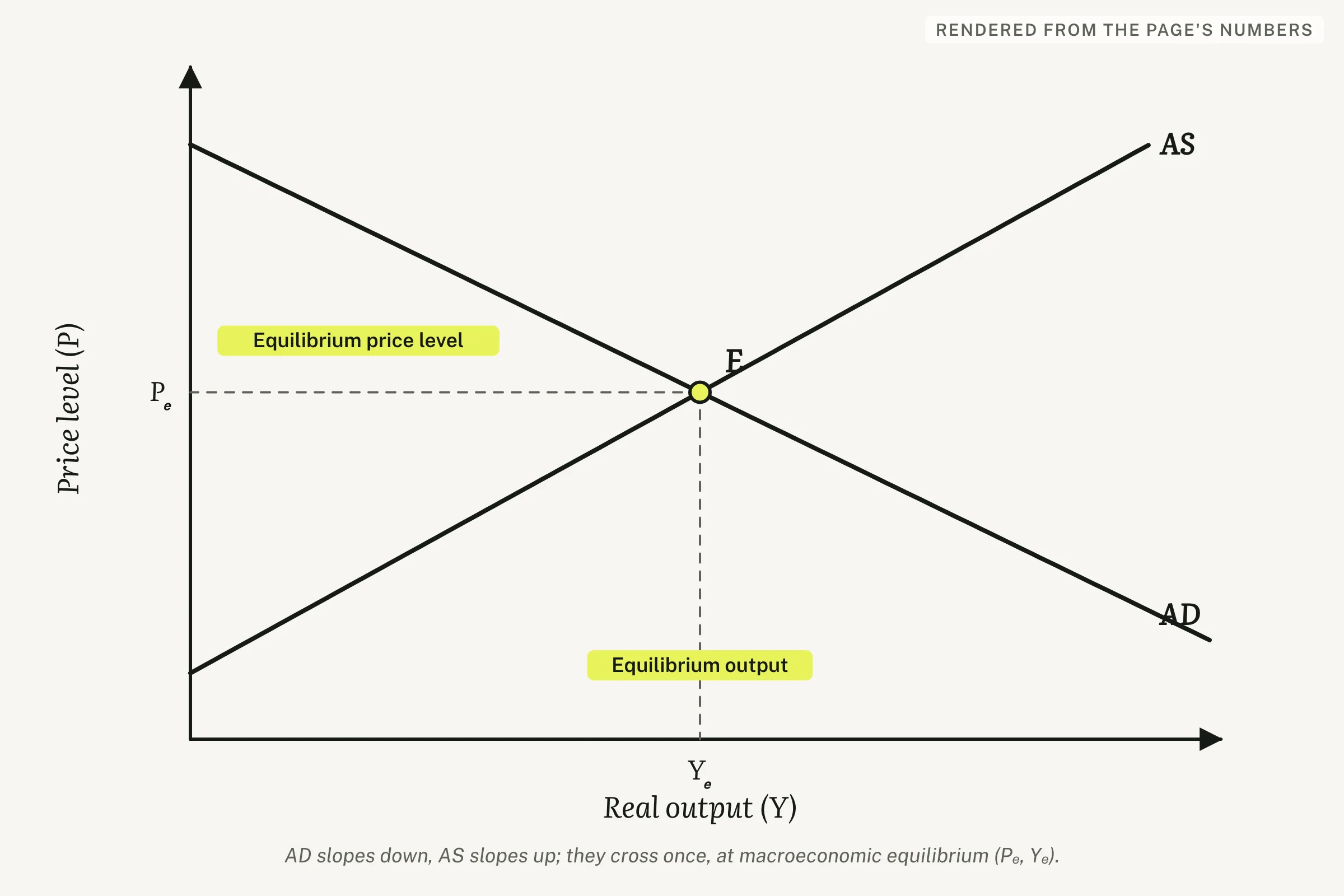
Macroeconomic equilibrium is the price and output level where aggregate demand and aggregate supply intersect — where total planned spending matches total planned production. Aggregate demand slopes downward because a lower price level makes buyers collectively want more; aggregate supply slopes upward because a higher price level makes producing more profitable.
What moves the equilibrium
A shift in aggregate demand — consumer confidence, government spending, export demand — moves the equilibrium along the supply curve, changing price and output the same direction. A shift in aggregate supply — input costs, technology, labor-force size — moves it along the demand curve, changing them in opposite directions. Once a macro course moves from definitions into regression on real GDP or unemployment data, the statistics desk handles that step.
The Chapter 1 questions your instructor will actually ask
- Not an economic resource: farmland, a delivery van, a $50 bill, or labor? Answer: the $50 bill.
- A farmer plants soybeans instead of corn. Which factor of production is that? Answer: entrepreneurship.
- What payment does land earn? Answer: rent.
- Why isn't a college degree an economic resource? Answer: a credential, not the graduate's labor.
- A point inside the production possibilities frontier means what? Answer: resources are idle.
- In a market economy, what allocates scarce resources? Answer: prices.
- What are the three basic economic questions? Answer: what, how, and for whom to produce.
- Which economy relies on central planning rather than prices? Answer: a command economy.
- Is national unemployment a macro or micro question? Answer: macroeconomics.
- If aggregate supply falls while demand holds, what happens to the price level? Answer: it rises; output falls.
If the whole econ problem set is due
Everything above covers the Chapter 1 vocabulary itself — the part most instructors test first, and the part a search engine can already answer in a snippet. If a full worksheet or problem set is due, that's a different kind of help, and our homework help hub routes each subject to its own page. If the assignment is a written econ paper rather than Chapter 1 vocabulary, see assignment and coursework writing service for the report format a marker expects.
Send the assignment sheet or a photo of it and you'll get a per-problem quote back within 2 hours, 8 am–11 pm ET, with the same worked-step format used throughout this page.
See my priceThis page sticks to Chapter 1 concepts. For the paid side of economics coursework, see economics homework help. If a history paper is due instead, history homework help covers that separately, and once a course moves into actual data, statistics basics picks up where descriptive statistics enters an intro economics sequence.
FAQ
More Chapter 1 economics questions, answered
Replies within 2 hours, 8 am–11 pm ET, 7 days a week
01Who gets scarce resources in a market economy?
Whoever is willing and able to pay the market price gets scarce resources — no central authority decides who receives what. Prices ration automatically: as a resource becomes scarcer, its price rises, buyers who value it less drop out, and it goes to whoever values it enough to pay.
02What would be an example of something studied in macroeconomics?
The national unemployment rate, the inflation rate, gross domestic product, and the interest rate set by the Federal Reserve are examples of something studied in macroeconomics — each describes the whole economy, not one household, firm, or market.
03What does "economic resources" mean, exactly?
Economic resources means the inputs — land, labor, capital, and entrepreneurship — that an economy combines to produce goods and services. The phrase is interchangeable with "factors of production" in every US principles-of-economics textbook, and when a worksheet says explain economic resources, it wants this same four-item list, never a definition of money or income.
04Who determines the allocation of resources in a market economy?
No single person or agency determines the allocation of resources in a market economy. The outcome comes from every buyer's and seller's decisions, coordinated through prices — the mechanism Adam Smith called the invisible hand.
05Is entrepreneurship really a separate factor of production, or just labor?
Most current US principles textbooks treat entrepreneurship as its own factor: it bears financial risk, earns profit rather than a wage, and decides how the other three resources combine. Older or more compressed courses fold it into labor — check which version your course uses.
06What's an everyday example of an economic resource?
A city bus (capital), the driver's shift (labor), diesel refined from crude oil (land), and a transit agency's decision to add a route (entrepreneurship) are all economic resources in one ordinary trip. Any good or service traces back to some combination of the same four.
07How is economic literacy different from just knowing economics vocabulary?
Economic literacy, a term used by groups like the Council for Economic Education, means applying concepts like scarcity and opportunity cost to real decisions, not just defining them. Knowing land earns rent is vocabulary; explaining why a city chooses one land use over another is economic literacy.
08Is a college degree an economic resource?
No. A college degree is a credential, not a factor of production. It represents an investment in the graduate's labor — often called human capital — but the resource used in production is the graduate's actual skill and effort, not the diploma itself.