An essay is a short piece of writing that argues one main idea — a thesis — and supports it with organized evidence and analysis in continuous prose. It has an introduction, body paragraphs that each open with a topic sentence, and a conclusion. A summary, a reflection log or a list of facts is not an essay; an essay always argues a position.
what is an essay
What Is an Essay? Structure, Format and Sample Essays
On this page
- What an essay is: a definition that survives a rubric
- The parts of an essay
- How to write an essay: the short version
- Essay format for college: margins, headings, spacing and citations
- APA essay example, fully formatted
- Short essay sample in MLA, with the structure labeled
- Essay types: which one you were assigned
- Scholarly vs school essay: what makes writing academic
- Human-written vs AI-generated essays: what graders actually notice
- Essay topics for college students
- Need it formatted for you: APA paper writing service
What an essay is: a definition that survives a rubric
What's an essay, in terms a rubric actually rewards? A short prose composition, typically 500 to 2,500 words, that states a thesis in the introduction, defends it with evidence and analysis across several body paragraphs, and closes by restating what the evidence proved.
The dictionary definition and what it leaves out
A dictionary defines an essay as "a short piece of writing on a particular subject." That's accurate and incomplete: it says what an essay covers, not what it does. An academic essay argues a position on its subject and defends that position with organized evidence. What does essay mean beyond the dictionary entry — a claim, defended, not a topic, described.
What counts as an essay and what does not
A report presents findings without defending a thesis. A reflection log records an experience without arguing a claim. A listicle enumerates items without one line of reasoning. A discussion post responds without full structure. An essay does what those genres skip: it states a position, organizes support, and closes on what the evidence proved — what constitutes an essay, distinct from its neighbors.
Where the word comes from (Montaigne's essai)
The word essay comes from the French essai, "an attempt" or "a trial," coined by Michel de Montaigne in the 1580s for short, exploratory prose that tested an idea rather than proving it. That looser sense is the essay definition in literature that survives in creative writing today. Academic essays kept the name but tightened the form: a modern instructor expects the "attempt" to end in a defended claim, not an open-ended musing.
The parts of an essay
An essay has three structural layers — introduction, body paragraphs, conclusion — and each layer has parts with a specific job. Skip one and a grader can point to exactly where the structure breaks.
Introduction: hook, context, thesis
The hook essay definition is simple: one sentence that earns attention without a gimmick. Specimen hook: "The four-day work week sounds like a perk; the data suggests it might be a fix." An essay hook generator drafts more options from your own topic. Two or three sentences of context bridge hook to topic, and the thesis — the essay's one-sentence thesis statement — states the position the essay defends. Writing an introduction paragraph has its own guide, with twelve examples by essay type. Not sure yours is strong enough yet? Score it with the free thesis statement generator.
Body paragraph: topic sentence, evidence, commentary, link
Each body paragraph opens with a topic sentence stating its one claim, follows with evidence, adds commentary explaining why the evidence proves the claim, and closes with a link back to the thesis. Specimen topic sentence: "Compressed schedules also reduce voluntary turnover, which lowers hiring costs."
Transitions
Transitions signal the logical relationship between paragraphs — however, similarly, as a result — rather than naming the next topic. Weak transitions are why a well-argued essay can still read as a list of paragraphs instead of one continuous argument. For a working list, see transition words for essays, by function.
Conclusion
A conclusion restates the thesis in new words (a restated thesis, never a verbatim repeat), synthesizes the body paragraphs' evidence into one closing insight, and avoids new evidence. A conclusion that only summarizes hasn't finished the job; it should say what the argument means. See how to restate a thesis without repeating it for the exact pattern, and how to write a conclusion that does more than summarize for the rest of the paragraph.
References or works cited
APA calls the final source page "References"; MLA calls it "Works Cited." Both list every source cited in the text and only those sources, alphabetized by author surname. The formatting differences are covered in the format section below.
How to write an essay: the short version
How to write an essay comes down to four moves: read the prompt for its verb, plan the essay claim by claim, draft the body before the introduction, and revise against the rubric line by line. Each move has its own traps, and the full step-by-step essay-writing process walks through every one, from choosing a topic to formatting the final draft.
Essay format for college: margins, headings, spacing and citations
Essay format for college usually means one of three style guides — APA 7, MLA 9 or Chicago — each with its own title-page, heading and citation rules. Using the wrong one is a formatting deduction even when the writing itself is strong.
APA 7: title page, running head, headings, references
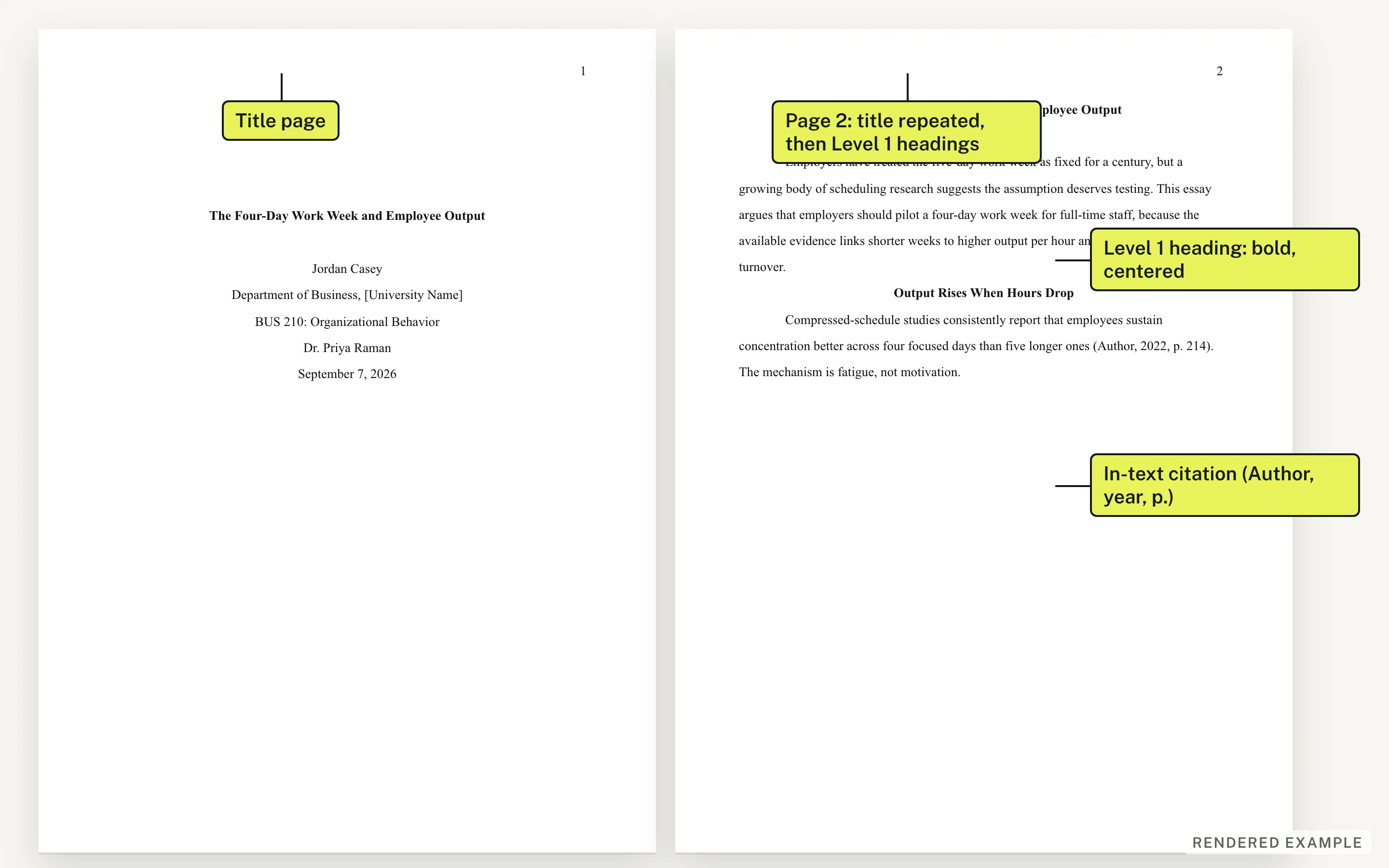
APA essay style wants a title page (title, author, institution), an optional running head for student papers under the current update (checked 2026-09-04), 1-inch margins, double spacing, level-1 bold centered headings, and a References page with a hanging indent.
MLA 9: header, first page, works cited
MLA 9 skips the separate title page: a four-line header (name, instructor, course, date) sits on page one, followed by a centered title, 1-inch margins, double spacing, and a Works Cited page with a hanging indent, alphabetized by surname.
What changes between them
| Element | APA 7 | MLA 9 |
|---|---|---|
| Title page | Separate page: title, author, institution | None — four-line header on page 1 |
| In-text citation | (Author, Year, p. #) | (Author page #) |
| Final page | References, hanging indent | Works Cited, hanging indent |
| Headings | Level-1 bold centered, level-2 bold left | Rare in short essays; used only if assigned |
| Typical use | Social sciences, education, nursing | Humanities, English, composition |
Chicago (footnotes plus a bibliography) shows up mainly in history and some business courses. Psychology is the most common APA course, and APA 7 psychology papers are the default on that desk; business essays built on case analysis follow whichever style the course names. When a prompt doesn't name a style, Purdue OWL's citation guides are a reliable free cross-check.
APA essay example, fully formatted
Below is a complete short essay formatted in APA 7 — title page elements, a level-1 heading, in-text citations and a reference list — so you can see the format applied, not just described. Use it as an apa template essay for your own draft's layout.
APA 7 sample essay — composite sample written by GradeDraft
Running head: THE FOUR-DAY WORK WEEK
The Four-Day Work Week and Employee Output Jordan Casey Department of Business, [University Name]
Introduction
Employers have treated the five-day work week as fixed for a century, but a growing body of scheduling research suggests the assumption deserves testing. This essay argues that employers should pilot a four-day work week for full-time staff, because the available evidence links shorter weeks to higher output per hour and lower voluntary turnover.
Output Rises When Hours Drop
Compressed-schedule studies consistently report that employees sustain concentration better across four focused days than five longer ones (Author, 2022, p. 214). The mechanism is fatigue, not motivation: attention narrows predictably after several consecutive workdays, and a shorter week interrupts that decline before it affects output.
Retention Improves
Turnover data from organizations offering schedule flexibility show lower voluntary exit rates than matched competitors on a standard week (Author, 2021, p. 4). Reduced hiring and onboarding costs offset the scheduling complexity a four-day model introduces.
Conclusion
The evidence does not suggest every role can shift to four days without adjustment, but it does suggest the five-day default is a habit, not a proven optimum. Employers willing to pilot a staggered four-day schedule stand to gain on two measures at once: output and retention.
References
Author, A. (2022). Scheduling and sustained attention in knowledge work. Journal of Occupational Scheduling, 14(3), 210–225.
Author, B. (2021). Flexible scheduling and voluntary turnover. Workforce Quarterly, 9(1), 1–12.
Short essay sample in MLA, with the structure labeled
Below is a short essay example in MLA 9 — an essay form sample of about 450 words — with each structural part labeled inline, written original for this page. For the same structure at full length, read a full-length argumentative essay sample in MLA 9.
MLA 9 sample essay — composite sample written by GradeDraft
Jordan Casey Professor Alvarez English 101 14 September 2026
Why Public Libraries Still Matter in a Digital Town
(Hook) A public library card costs nothing and unlocks more than most people ever borrow. (Context) Digital access has made information cheap, but it has not made it equally available, and small-town libraries still close that gap for residents who cannot afford broadband or a personal device. (Thesis) Public libraries deserve continued local funding because they provide free internet access, staffed research help, and a physical space that a website cannot replace.
(Topic sentence) Free internet access is the most immediate service a library provides. (Evidence) In towns where home broadband is unaffordable, the library's public terminals are often the only reliable connection a resident has for job applications, school portals, and government forms. (Commentary) Removing that access would not just inconvenience these residents; it would cut them out of processes that now assume everyone is online. (Link-back) This single service already justifies the library's line in a town budget.
(Topic sentence) Staffed research help extends that access into actual skill-building. (Evidence) A librarian can teach a patron to evaluate a source, request an interlibrary loan, or navigate a database a search engine does not index. (Commentary) No app replicates that one-on-one guidance at no cost to the patron. (Link-back) Access without instruction is only half the service; libraries provide both.
(Topic sentence) Finally, the physical space itself does work a website cannot. (Evidence) Study rooms, children's story hours, and public meeting space give a town a shared, no-cost venue. (Commentary) A digital archive can hold a library's books; it cannot hold a town's after-school program. (Restated thesis) Public libraries earn their funding not as a nostalgic holdover but as active infrastructure — for internet access, for research skill, and for shared civic space.
Works Cited
Example Author. Local Libraries in the Broadband Gap. Civic Press, 2023.
Essay types: which one you were assigned
The prompt's verb names the type before the topic does: argue calls for an argumentative essay, analyze for an analytical one, explain for an expository essay, narrate for a narrative, and define for a definition essay. Match your thesis to that type before you plan, using every essay type, with the thesis pattern for each.
Scholarly vs school essay: what makes writing academic
Hedging separates the two first: scholarly writing qualifies its claims ("the evidence suggests," not "this proves"), while school essays often overclaim.
Citation practice differs next: scholarly work cites the specific claim it supports, not just the source at the end of a paragraph; school essays tend to under-cite.
Register matters too: a scholarly essay uses field-specific terms precisely instead of swapping in a vaguer synonym for variety's sake.
Source quality is the clearest tell: scholarly essays draw on peer-reviewed sources vetted through peer review before publication, or on primary sources directly; school essays often lean on general encyclopedic summaries or news coverage instead.
Human-written vs AI-generated essays: what graders actually notice
Graders increasingly compare a submission against generic AI output on the same prompt. Two short paragraphs below answer "Should schools require handwritten exams?" — one AI-shaped, one human-shaped.
AI-shaped: "Handwritten exams offer several benefits for students in educational settings. They can improve memory retention and reduce reliance on technology. Additionally, handwritten exams may help prevent academic dishonesty. Overall, handwritten exams provide a valuable tool for assessing student learning while also encouraging traditional skills that remain important in today's educational landscape."
Human-shaped: "My high school switched to handwritten exams after a cheating scandal in 2019, and the immediate effect wasn't better memory — it was slower typing-speed complaints from students used to laptops. Three semesters later, though, my study habits had changed: without spell-check, I reviewed vocabulary before tests instead of during them, which is the only measurable difference I can point to."
The tells: unsourced generalization ("in educational settings," "in today's landscape"), symmetrical sentence and paragraph lengths, no specific date or evidence, and hedge-free confidence stacked sentence after sentence. Turnitin's and GPTZero's AI-detection scores are one signal among several, not proof on their own — this page only names what a human reader notices first. To see how your own draft reads on thesis, evidence and voice, run your draft through the free essay checker; it scores the writing, not who wrote it.
Essay topics for college students
A short college essay topics list, grouped by the type that owns the full bank:
- Argumentative: Should colleges require a work-study component for all four-year degrees?
- Narrative: Describe a moment you changed your mind about something you were sure of.
- Analytical: How does an assigned short story's structure affect its central meaning?
- Definition: What does "financial literacy" actually require, beyond budgeting?
- Expository: Explain how a FAFSA application actually gets processed.
Longer banks are organized the same way: 150 argumentative essay topics by level and theme, personal narrative ideas by grade for the narrative prompt, and opinion topics sorted by grade level for shorter opinion pieces. Essay title ideas by type then turns a chosen topic into a working title.
Need it formatted for you: APA paper writing service
Formatting eats time a deadline doesn't always allow — a title page, running head, level-1 headings and a hanging-indent reference list all have to match APA 7 or MLA 9 exactly, and one missed rule can cost a point even on strong writing. If you'd rather pay someone to write your essay from the prompt than format it yourself, GradeDraft's desk can draft it, or take a finished draft and format it to spec, in APA 7, MLA 9 or Chicago.
Send your prompt or your draft, the citation style, and your deadline. We'll quote a fixed price before you commit.
Get your essay drafted or formattedFAQ
Essay basics: common questions
Replies within 2 hours, 8 am–11 pm ET, 7 days a week
01Is there another word for essay?
Depending on context: "composition" and "paper" are the closest general synonyms, "theme" is an older term still used in some high schools, and "personal statement" or "response paper" name specific essay types rather than the category itself. In everyday academic use, "essay" and "paper" are close to interchangeable.
02How long should a college essay be?
It depends entirely on the assignment — a discussion-post-length response can run 300 words while a term paper runs 2,500 or more. See how long an essay should be for a level-by-level breakdown.
03What's the difference between an essay and a research paper?
An essay can be argued from general knowledge and a handful of sources; a research paper requires a structured review of existing scholarship and usually a longer reference list. The line blurs at the undergraduate level, where instructors sometimes use the terms loosely.
04Can I use first person in an academic essay?
It depends on the discipline and the assignment. Narrative and reflective essays expect "I"; argumentative and analytical essays in the humanities increasingly allow it for a stated position ("I argue that..."), while STEM and some social-science rubrics still prefer third person. Check the rubric before you draft.