Do My Accounting, Finance and Economics Homework
— 1 —
do my accounting homework
Accounting, finance and economics problem sets get marked on the file you submit as well as the final number. Ask us to do my accounting homework, do my finance homework, or an economics problem set, and what comes back is a working Excel file with live formulas and a labeled diagram, not a screenshot you can't edit.
Nothing upfront — a Stripe invoice (card or bank transfer) after you approve the delivered draft
Send my briefDo my excel homework and excel assignment help requests share one graded requirement most services skip: formulas must survive delivery. Most services ranking for accounting assignment help are essay-writing sites that never name a file format or software. A PDF fails an Excel assignment even when the numbers are right.
Every workbook keeps its formulas live: click a total and you see the SUM or lookup that built it instead of a typed-in number. Named ranges replace bare cell references (TaxRate instead of $B$4), and a separate assumptions tab lists every model input: interest rate, tax rate, useful life, unit cost.
A PDF shows what a formula returned, not the formula itself. Instructors grading Excel homework open the file and check the build before the final numbers.
We build in current Excel (.xlsx, Windows and Mac) or Google Sheets, and can save to .xls or export a matching CSV on request.
A do my accounting homework request starts here: entries, then ledgers, then statements. Every entry we post shows on a T-account so you see which side moved, whether you need help with accounting homework on one transaction or a full closing cycle.
Example. Bright Path Tutoring, a sole proprietorship, records five October transactions:
| Debit | Credit |
|---|---|
| Oct 1: $10,000 | Oct 5: $1,000 |
| Oct 28: $1,500 | Oct 20: $600 |
| Total debits: $11,500 | Total credits: $1,600 |
| Ending balance: $9,900 (debit) |
That's where a do my accounting assignment build goes wrong most often: a compound entry (transaction 2 has three lines) gets posted as two lines, and the third (the $2,000 note payable) disappears.
| Account | Debit | Credit |
|---|---|---|
| Cash | $9,900 | |
| Accounts Receivable | $1,000 | |
| Equipment | $3,000 | |
| Notes Payable | $2,000 | |
| Owner's Capital | $10,000 | |
| Service Revenue | $2,500 | |
| Rent Expense | $600 | |
| Totals | $14,500 | $14,500 |
Both columns land on $14,500, confirming the ledger balances. Adjusting entries (accrued expenses, unearned revenue, depreciation) come next, then closing entries zero revenue and expense into Owner's Capital for a clean start next period.
The income statement, statement of owner's equity and balance sheet draw from the same adjusted trial balance: Bright Path's $1,900 net income flows through to the balance sheet. We build to GAAP by default, flagging IFRS differences when required.
Cost-volume-profit, job-order/process costing, and FIFO or LIFO inventory costing each yield a different cost of goods sold. We also handle managerial case studies; for a written business case, see business and MBA assignment help. A one-file task such as a short budget memo or a single costing deliverable can run as a one-off assignment order instead.
Finance homework help and do my finance homework for me requests split into a numeric set (NPV, WACC, bond pricing) and a written case; this section covers the numeric side.
NPV and IRR: discounted cash flow (composite sample written by GradeDraft)
Problem. A project needs a $50,000 initial investment and returns $15,000, $18,000, $20,000, $16,000 and $14,000 over years 1-5, at a 10% required return. Find the NPV and decide whether to accept.
| Year | Cash flow | Discount factor | Present value |
|---|---|---|---|
| 0 | -$50,000 | 1.0000 | -$50,000.00 |
| 1 | $15,000 | 0.9091 | $13,636.50 |
| 2 | $18,000 | 0.8264 | $14,875.20 |
| 3 | $20,000 | 0.7513 | $15,026.00 |
| 4 | $16,000 | 0.6830 | $10,928.00 |
| 5 | $14,000 | 0.6209 | $8,692.60 |
Scroll the table sideways to see every column.
Boxed answer: NPV = $13,158.30 (positive) → accept. IRR ≈ 19.9%.
WACC blends the cost of equity and after-tax cost of debt, weighted by capital structure:
Bond price is the present value of its coupons plus face value, discounted at market yield. Equity under the dividend discount model prices as , breaking the moment .
A two-asset portfolio's expected return is the weighted average of the two assets' returns, but its risk isn't: correlation pulls total variance below that average, which is the mathematical case for diversification. We model these in Excel with inputs laid out like a trading desk screen.
Send your problem set or finance model and get a fixed price and turnaround before you commit.
See my priceExcel homework help spans a single lookup formula to a full multi-sheet financial model; do my excel homework requests below cover the range.
Do my excel assignment requests usually fail the same way: a missing absolute-reference dollar sign in a dragged formula, a VLOOKUP / XLOOKUP with the wrong column index, or a missing IFERROR wrapper letting one divide-by-zero break the sheet. We default to XLOOKUP where supported and wrap anything that can fail.
A pivot table turns a flat transaction list into a summary by category, month, or region without one formula; we build the source data as a proper table first. Dashboards layer a chart and key totals on top.
A financial model with a scenario switch (one dropdown flipping every number between "base," "best," and "worst" case) is what a finance capstone wants. A static forecast falls short. The switch drives named ranges, updating the whole model from one cell.
Excel homework often spans linked sheets: a data tab, a calculations tab, and a summary tab pulling from both. When you pay someone to do your Excel homework here, the workbook comes back with each sheet named for its role and cross-sheet formulas documented on the assumptions tab. For VBA macros and database-driven assignments, see VBA and database assignments.
Economics homework help splits the way the course does: microeconomics (markets and firms) and macroeconomics (the whole economy). Do my economics homework requests come in both, and we work as an economics helper for one problem or a full set.
Elasticity measures how quantity responds to a price change: . A price rising 10% that cuts quantity 20% gives : elastic, so revenue falls as price rises. Cost-curve and market-structure problems round out the set. Equilibrium questions are algebra underneath: market equilibrium is a two-equation system, so demand and supply are solved together for the one price and quantity that satisfy both (, ).
AD-AS problems ask you to shift one curve and read the new equilibrium price level and output; fiscal and monetary policy shift AD differently. GDP problems using the expenditure approach,
Economics tutoring at the AP level runs $55/hour, matched to the College Board's free-response format. An ap macroeconomics tutor session works the FRQ rubric directly, since FRQs are graded on labeled steps as much as the final answer; the same applies to AP Microeconomics.
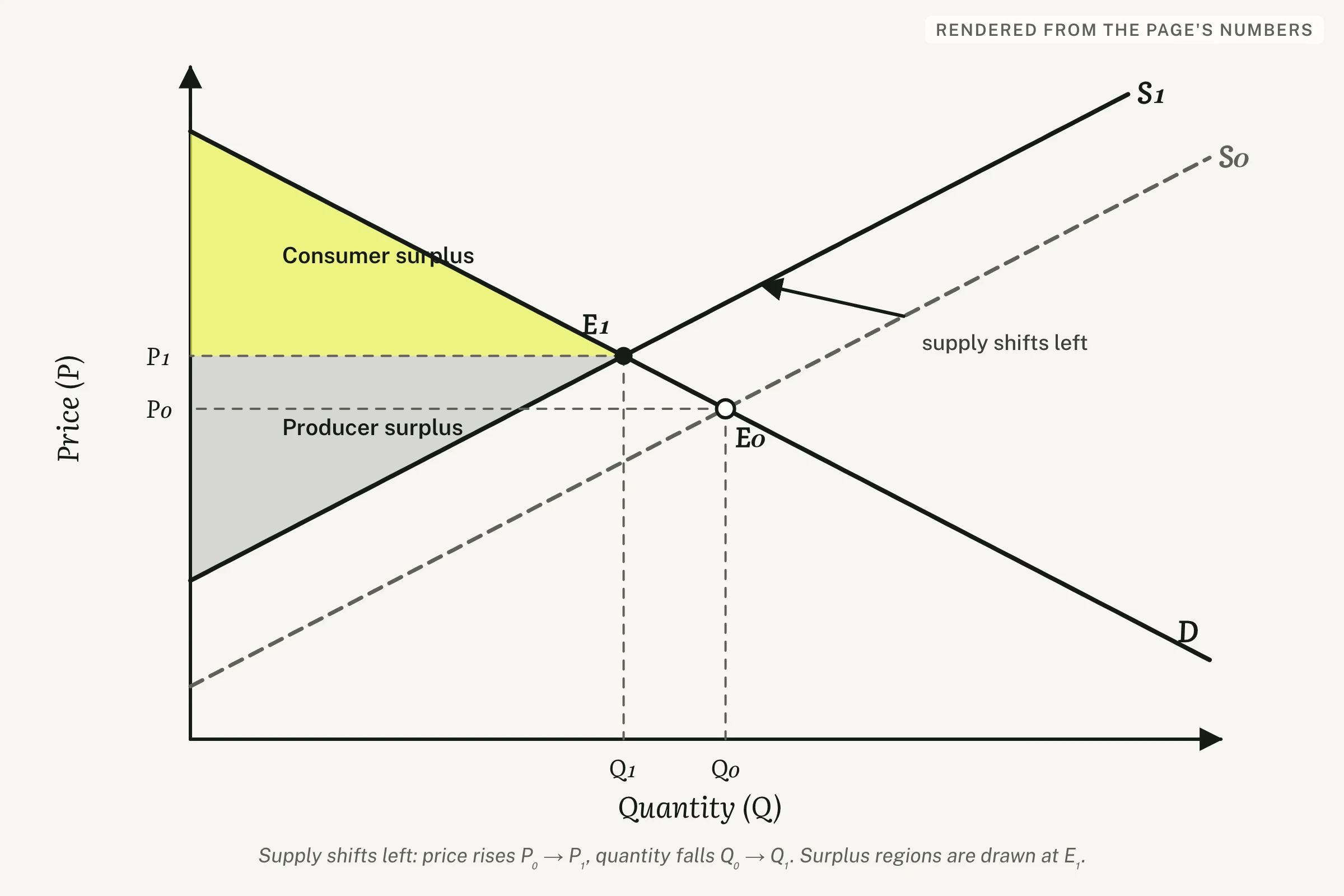
Economics problem sets are marked on labeled graphs, so we deliver every diagram as an editable file, matched to how your course draws them. The same principle drives a geometry proof: the grade sits in the labels on each step as much as in the final shape.
An accounting ai solver is fast at one isolated entry and unreliable once entries link together, which is most of a real assignment. The homework hub publishes a ten-problem AI-vs-human test across subjects; the pattern below is the accounting-specific version of the same failure mode.
Tools marketed as the best ai for accounting homework tend to fail on exactly the Bright Path ledger shape. Post the Oct 5 purchase as a two-line entry, dropping the note payable, and the trial balance still "balances" at $12,500: a dropped compound-entry line keeps debits equal to credits while deleting a liability.
Asked to shift a supply curve for a per-unit tax, an economics ai solver can get the shift amount right and still place the new equilibrium at the old, pre-tax quantity, contradicting its own algebra.
The same failure compounds fast in a linked spreadsheet: one wrong formula flows into every cell referencing it, misstating the whole model. That is also the best ai to solve microeconomics problems question in practice: fluent on one calculation, wrong once several must agree.
We name the software because most services don't. A page promising to do my excel homework for me without naming a spreadsheet version hasn't built the file.
Microsoft Excel, current versions, Windows and Mac; Google Sheets on request.
Supported for bookkeeping: chart of accounts, transaction entry, report generation.
SAP coursework: module navigation, transaction codes, basic reporting.
Stata handles regression-based econometrics assignments; for the statistics behind these models, see statistics and data analysis help.
Accounting help online searches sometimes mean accounting aid, as in the Accounting Aid Society, a nonprofit tax-prep charity. If that's you, this isn't the right page; we handle paid accounting assignment help, not tax filing. GradeDraft is independent of and not affiliated with Pearson MyAccountingLab, Connect, QuickBooks, Xero, or SAP. If your course runs the problem set through a platform like Pearson MyLab or XYZ Homework instead of standalone software, see online homework answers (XYZ, MyLab, Pearson) for how attempt limits and randomized numbers change a quote.
Problem sets price from $25 per problem after review; Excel projects and full workbooks get a fixed quote once we've seen the scope. See pay someone to do my homework for the homework rate table, or our pricing page for every rate on the site.
Same-night and 24-hour delivery are both available; anything under 12 hours adds a 40% rush fee, for Excel, accounting and economics sets alike.
Nothing is paid upfront. You approve the quote, we deliver, and a Stripe invoice (card or bank transfer) arrives only after you approve the delivered work. How it works shows each step, and the guarantees page sets out revisions and refunds. Your set goes to the STEM & homework desk on our writers page, and sample workbooks and problem sets are in the samples library.
Brief received
Reference GD-000000
A priced quote comes back to your email. Replies within 2 hours, 8 am–11 pm ET, 7 days a week.
Add your files and detailsSend your accounting, finance or economics set
Send your problem set or Excel project and get a fixed price and delivery time before you commit.
Replies within 2 hours, 8 am–11 pm ET, 7 days a week
FAQ
Replies within 2 hours, 8 am–11 pm ET, 7 days a week
Yes. Send the problem set or ledger and we quote a fixed price per problem, from $25 after a quick review. The file that comes back has live formulas and every entry posted to its T-account, not just a final number typed into a cell.
Same-night delivery covers most problem sets received before evening; anything genuinely urgent, under 12 hours, adds a 40% rush fee rather than risk missing the deadline. Send the set as soon as you have it so review starts early and the quote lands fast.
The workbook: live formulas, named ranges, and a documented assumptions tab, not a flattened printout. A PDF of numbers doesn't demonstrate the build a spreadsheet assignment is actually graded on, even when every value in it happens to be correct.
Yes, both, along with Xero and current Excel on Windows or Mac; tell us which one your syllabus specifies and which file format your course expects, and we match it exactly in the delivered workbook, chart of accounts included.
Yes. The worked NPV example above shows the cash-flow table and discount-factor method we use, and WACC, bond and equity valuation, and portfolio-risk problems all follow the same fully-shown-work approach, symbolic first, not a bare final answer with no method behind it.
Yes, both AP Macroeconomics and AP Microeconomics, tutored at $55/hour or solved to the College Board's free-response format, with diagrams delivered as editable files rather than flattened images students can't relabel or annotate for their own review.
Send the problem set and note whether it's micro, macro, or both; we quote a fixed price after a quick review and, for graph-heavy sets, deliver every diagram as an editable file, not a flattened image you can't relabel or edit yourself.
We never ask for your LMS login, portal password, or student ID, you are invoiced only after you approve the delivered work, and revisions stay free for 14 days after delivery, matching the policy across every subject on the site.