Lab Report Writing Service - Hire a Lab and Technical Report Writer
— 1 —
lab report writing service
A lab report is not a paper built from sources; it is a report paper built from your own measurements, and a lab report writer works from your data, not from a library search. GradeDraft's lab report writing service is part of the wider custom research paper writing service, covering chemistry, biology, physics and engineering courses, and the same writers handle the wider technical-report family (lab reports, business technical reports, and engineering computation paper) because the underlying skill is the same: turning numbers into a defensible argument. If you need lab report help on a deadline, send the raw data and the handout; the report comes back in full IMRaD form, written by a human writer with no AI drafting. Pricing follows the page rate from $12.99, and nothing is paid upfront: you are invoiced after you approve the draft.
Per page (275 words, double-spaced), USD · 14 days.
Nothing upfront — a Stripe invoice (card or bank transfer) after you approve the delivered draft
Send my briefIMRaD is not a formatting requirement bolted onto a report; it is the shape the scientific method takes on paper. One small dataset, a triplicate acid-base titration, shows how raw numbers become each section. For a longer worked model, see the IMRaD anatomy in a full sample paper, or a full lab report built from one small dataset, written up for a biology course.
The hypothesis is written so it can be checked, not just stated: "the concentration of an unknown NaOH solution can be determined within 2% of its true value by titration against a standardized 0.100 M HCl solution." A vague hypothesis produces a Discussion with nothing to answer.
The Method is written so a stranger could repeat the experiment without asking a question: "A 25.00 mL aliquot of the unknown NaOH solution was pipetted into a 125 mL Erlenmeyer flask and titrated against 0.100 M HCl using phenolphthalein as the indicator, with the buret read to the nearest 0.05 mL at three independent trials." Past tense, passive voice, third person: the reader, not the researcher, is the subject.
Results present the numbers before interpreting them.
| Trial | Initial buret reading (mL) | Final buret reading (mL) | Volume delivered (mL) |
|---|---|---|---|
| 1 | 0.00 | 24.30 | 24.30 |
| 2 | 0.00 | 24.60 | 24.60 |
| 3 | 0.00 | 24.10 | 24.10 |
Scroll the table sideways to see every column.
Mean volume:
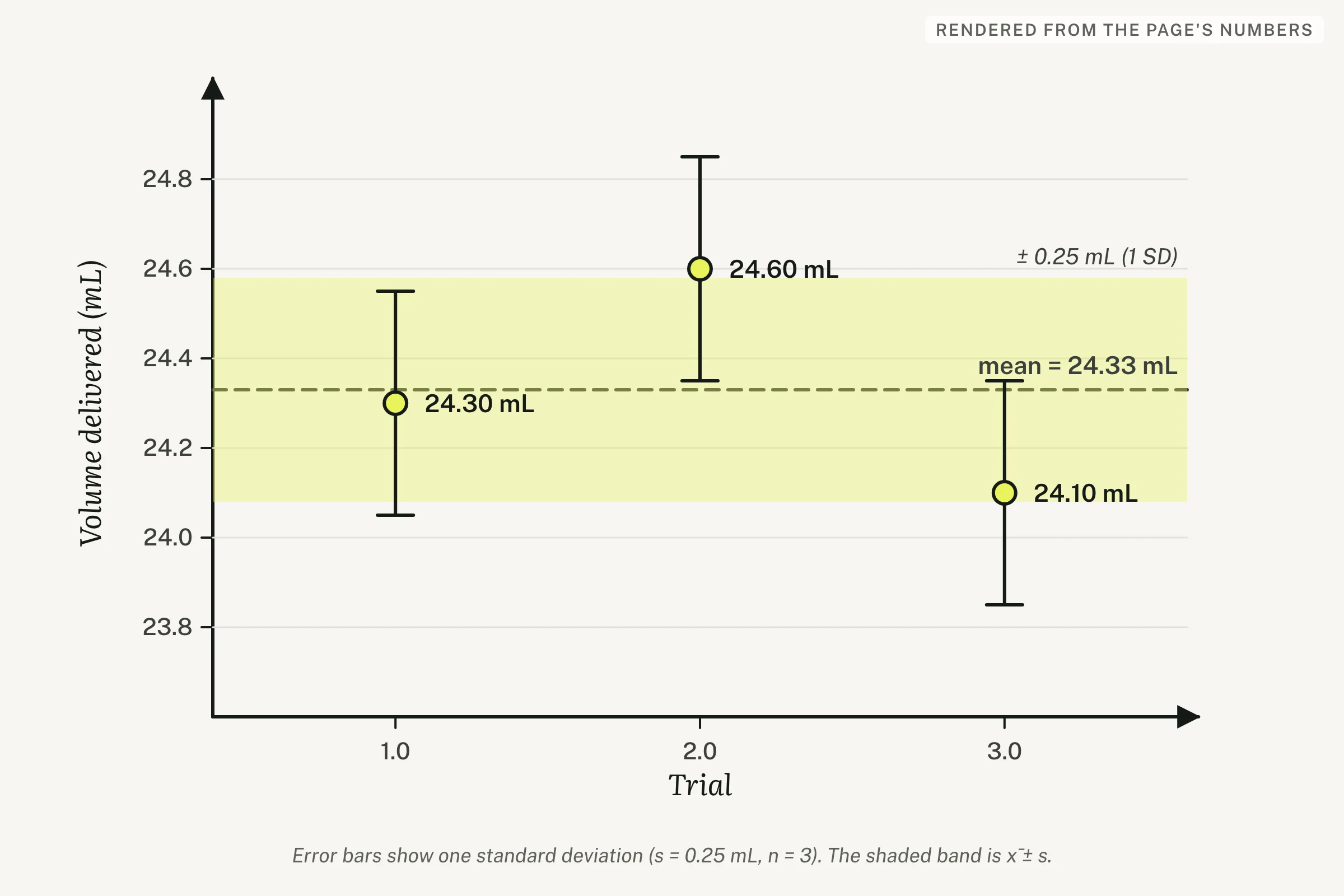
The Results sentence this data produces: "The mean titration volume was 24.33 mL ± 0.25 mL (n = 3), corresponding to an NaOH concentration of 0.097 M ± 0.001 M."
The Discussion answers the Introduction's hypothesis directly: "The measured concentration of 0.097 M falls within the 2% target set in the hypothesis, supporting the method's precision for this application." The error analysis follows: a relative standard deviation of about 1% across three trials points to buret-reading precision (±0.05 mL) as the dominant error source, ahead of indicator-endpoint overshoot, which would bias the result high rather than add random scatter.
From raw readings to a reported concentration (composite sample written by GradeDraft)
A report writer works from what you send, so "write my lab report for me" starts with a data handoff, not a blank order. The steps are laid out on how it works, and desk scopes on who writes and reviews your paper.
Send the numbers as you recorded them (a Microsoft Excel or CSV file, or the direct output from a spectrometer, plate reader, or data-acquisition instrument) rather than a rounded summary. Raw values let the writer choose the right significant figures instead of guessing them.
If you already plotted a graph in Excel, OriginLab, MATLAB, or R, send the file so axis labels and error bars can be checked. If you have not plotted anything yet, send the raw numbers and a graph is built to match the Results section.
Every reported number carries a unit and a sensible number of significant figures, matched to instrument precision rather than to however many digits a calculator displays. State which calculations you have already run so the writer does not repeat work you have done.
The lab manual or course handout sets the required sections, the citation style, and often the exact question the Discussion must answer. Send it along with the data, because "do my lab report for me" without the handout means guessing at your instructor's rubric. If your lab report's literature review needs a full annotated source list rather than in-text citations only, annotated bibliography writing services covers that separately.
| Format | What it is | Note |
|---|---|---|
| .xlsx / .csv | Raw spreadsheet data | Include column headers with units |
| Instrument export (.txt, .dat, proprietary) | Direct output from an instrument or DAQ | Send the raw export, not a screenshot |
| Photographed notebook pages | Handwritten raw data or observations | Clear, legible, well-lit photo |
| .docx / PDF | Lab manual or assignment handout | Sets required sections and rubric |
A technical report documents a project, test, or investigation for a workplace or capstone audience rather than a course instructor, and it is judged on whether a decision-maker can act on the executive summary alone. A lab report assumes the reader already knows the experiment; a technical report cannot assume that. When the assignment is a business scenario rather than a lab experiment, it is written as one of our business case studies instead.
Technical report format runs title page, executive summary, introduction, body or analysis, conclusion, and appendices, in that order, with the summary written last but placed first.
| Section | Share of report length | Purpose |
|---|---|---|
| Title page | not counted | Title, author, date, course or company |
| Executive summary | 5-10% | Decision-ready summary, readable alone |
| Introduction | 10% | Problem, scope, objectives |
| Body / analysis | 60-65% | Method, data, findings, discussion |
| Conclusion | 10% | What the findings mean, recommendation |
| Appendices | not counted | Raw data, code, supporting documents |
The conclusion of a technical report restates the finding and states its consequence in the same breath. Not "the mean was 24.33 mL," but "the mean of 24.33 mL confirms the process met the required tolerance, and no further calibration is needed before the next production run."
A sample of a technical report walks a decision-maker through the same triplicate dataset above, reframed for a workplace audience: the executive summary states the 0.097 M result and its pass/fail against a 0.095-0.100 M specification in the first two sentences, before the body section explains how it was measured. The full sample paper linked above shows the complete IMRaD format, section by section, and more finished work is on the samples page.
Send your raw data, your lab manual or handout, and your deadline. A per-page price comes back within two hours, 8 am-11 pm ET.
See my priceEngineering computation paper carries a fixed header block (name, date, course or project number, page number) filled in before any work goes on the grid, plus a title line for the problem being solved.
Engineering paper format keeps one problem per page where possible, shows every step of a calculation rather than a final answer alone, and boxes the final answer with its unit so a grader can find it without rereading the page.
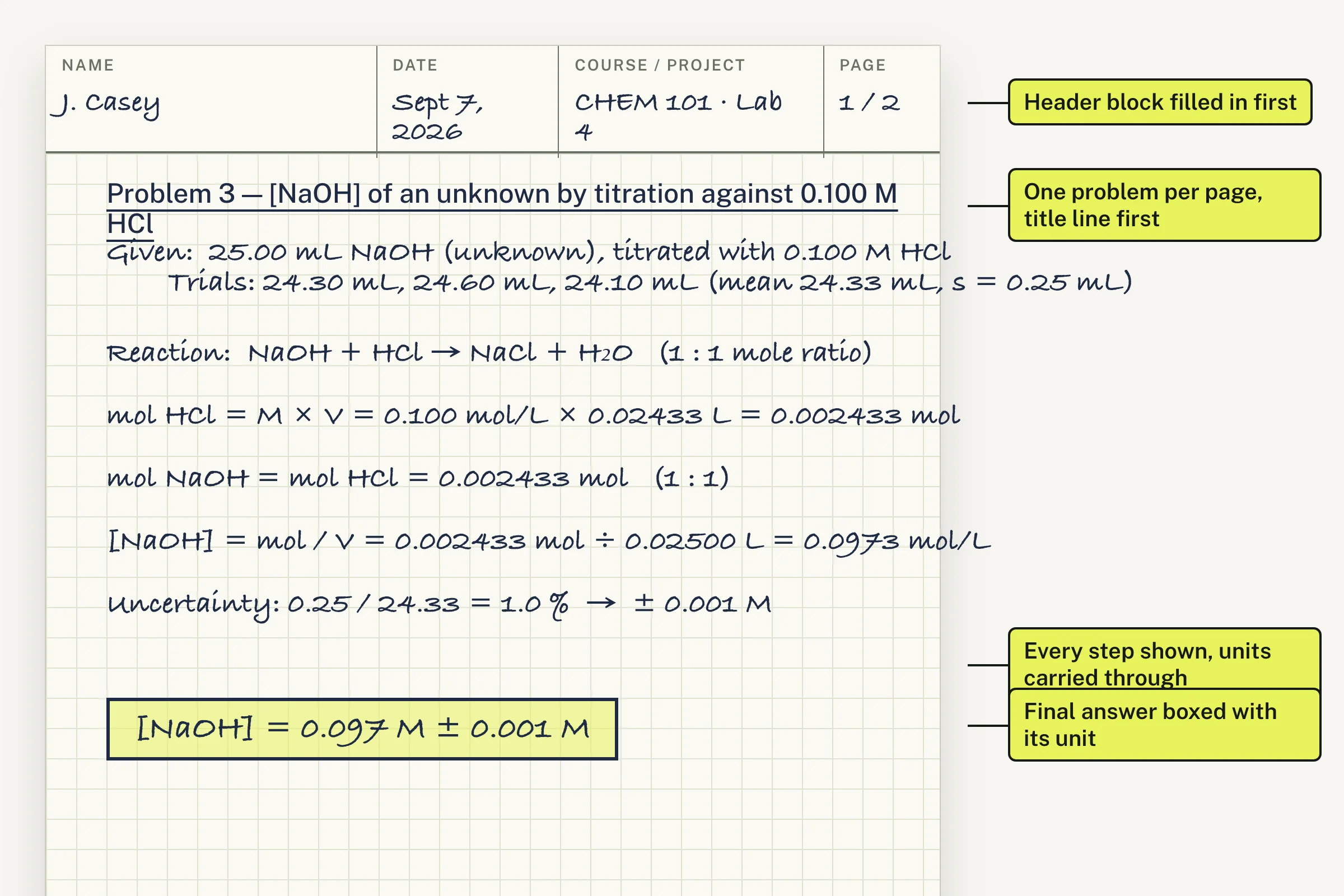
Some engineering and physics courses still require handwritten computation sheets even when the report itself is typed, because the grid paper is what shows the actual work as well as the result. Check your syllabus before submitting a typed-only version.
Ai help with my lab report is a real, common search, and the honest answer is that a model cannot help with the part that matters most: it has no access to your actual measurements and will invent plausible-sounding values instead of using yours. Can ChatGPT write a lab report? A version of it, yes, but it cannot run your error analysis, because that requires your real standard deviation, not an average one pulled from training data. Where AI genuinely helps is rephrasing a Method section you already drafted, or explaining a statistical term back to you in plain language. Treat it as a study aid, not the writer of record for a report tied to your own experiment.
Should lab reports be written in first person? It depends on discipline. Chemistry, physics, and most engineering courses still expect passive voice and third person throughout ("the solution was heated," not "I heated the solution"), while some biology and social-science methods sections now permit first person for the researcher's own actions. Check your handout; when it is silent, default to passive and third person.
| Deduction | Before | After |
|---|---|---|
| First person where the discipline requires third | "I measured the pH every 5 minutes." | "The pH was measured every 5 minutes." |
| Present tense in a Method section | "The solution is heated to 60°C." | "The solution was heated to 60°C." |
| Missing units on a reported value | "The mass was 4.52." | "The mass was 4.52 g." |
| Conclusion restates results without interpreting | "The mean was 24.33 mL." | "The mean of 24.33 mL confirms the titration reached the expected endpoint within 1%." |
| Significant figures beyond instrument precision | "The volume was 24.334521 mL." | "The volume was 24.33 mL (buret precision: ±0.05 mL)." |
A lab report is faster to write than a research paper, because there is no source hunt: the data already exists, and the writer's job is method, analysis, and prose. A realistic minimum for a standard undergraduate lab report with your data in hand is 24 hours; same-day turnaround uses the 6-hour column of the rate card ($34.99 per page at undergraduate level). If the same dataset also needs presenting, GradeDraft covers lab talks and poster sessions built from the same numbers. Citation style follows your course: ACS style for chemistry, IEEE for engineering, AMA or Vancouver for health sciences, CSE for biology. State which one your handout requires when you order. See the complete per-page rate card at pricing for every deadline tier, and the revision terms at guarantees. If the lab work is only one section of a longer paper, price the whole job as a non-lab paper written for you, or order a research paper instead, with your data as one of its sources.
Brief received
Reference GD-000000
A priced quote comes back to your email. Replies within 2 hours, 8 am–11 pm ET, 7 days a week.
Add your files and detailsSend my brief
Send your data, your handout, and your deadline. Pricing comes back itemized by page before you commit to anything.
Replies within 2 hours, 8 am–11 pm ET, 7 days a week
FAQ
Replies within 2 hours, 8 am–11 pm ET, 7 days a week
It depends on discipline. Chemistry, physics, and most engineering courses expect passive voice and third person; some biology and social-science methods sections now allow first person for the researcher's own actions. Your handout overrides any general rule.
Only where your discipline or instructor explicitly allows it, and usually only in the Method for describing your own actions, never in Results or Discussion, which report the data and its meaning, not your experience of collecting it.
It can produce a draft that reads like one, but it cannot run your error analysis or use your real measurements, since it has no access to either. A human lab report writer works from your actual dataset instead of a plausible substitute.
With your data already collected, a standard undergraduate lab report takes about 24 hours; a same-day report is available at the 6-hour rate. Reports involving new statistical analysis or a large dataset run closer to 48 hours.
Cite the organization or author, the report title, the report or document number if one exists, the publisher or issuing body, and the year, formatted to whichever style your field uses: ACS, IEEE, AMA, Vancouver, or CSE.
Length follows purpose, not a fixed page count: a course-assigned technical report often runs 8 to 15 pages excluding appendices, while a workplace report can be shorter if the executive summary alone answers the decision-maker's question.