A quadratic equation has three common forms of quadratic equations: standard form (), vertex form (), and factored form (
forms of quadratic equations
Forms of Quadratic Equations: Standard, Vertex and Factored (With Examples)
On this page
- What's the quadratic equation? Definition in plain English
- The three forms, side by side
- Convert between forms without a calculator
- Quadratic equation examples in each form
- Solving with the quadratic formula
- When to use the quadratic formula vs factoring vs completing the square
- Forming a quadratic equation from roots or from a word problem
- Practice questions for quadratic equations, with answers
- When the quadratics unit is graded and there are forty of them
What's the quadratic equation? Definition in plain English
The defining feature: a squared term and nothing higher
A quadratic equation is any equation that can be written with a squared variable term, a linear term, and a constant, with no higher power anywhere. In symbols: , where . Drop the squared term and it's linear, and a linear function with no constant term, , is a direct variation, the simplest line through the origin; add a cubed term and it's no longer quadratic.
Quadratic equation vs quadratic formula vs quadratic function
Three related terms get fused together in student searches, and they aren't the same thing. The quadratic equation is the statement you're trying to solve. The quadratic formula is one specific tool for solving it:
Quadratic equation def in one sentence
Quadratic equation def, short version: an equation where the highest power of the variable is 2, written in one of three interchangeable forms of the quadratic equation — standard, vertex, or factored — each of which hands you a different piece of information about the parabola without any extra work. This shows up first in Algebra 1 as an introduction, returns in Algebra 2 as a full unit, and appears directly on SAT Math and under Common Core standard HSA-REI.B.4. If a unit test is what's coming, exam prep for a quadratics test runs timed practice on exactly these forms; if it's a graded worksheet you can't get to, do my assignment for me hands the whole file to a specialist.
The three forms, side by side
The forms of a quadratic equation are just different ways to write the same relationship — every one describes the exact same parabola. The differences are only in what each one hands you immediately, and what it forces you to calculate. Take one concrete example and hold it constant: .
Standard form: ax² + bx + c - reads off the y-intercept
Standard form is , with , , . Read the y-intercept straight off : the parabola crosses the y-axis at . Standard form is also the form the quadratic formula expects, so it's the starting point for solving.
Vertex form: a(x - h)² + k - reads off the vertex and axis of symmetry
The same parabola in vertex form is . The vertex sits at
Factored form: a(x - r)(x - s) - reads off the roots
The same parabola in factored form is
One parabola, three ways to write it
| Form | Equation | Hands you free | Hides |
|---|---|---|---|
| Standard | y-intercept | vertex, roots | |
| Vertex | vertex | roots, y-intercept | |
| Factored | roots | vertex |
Scroll the table sideways to see every column.
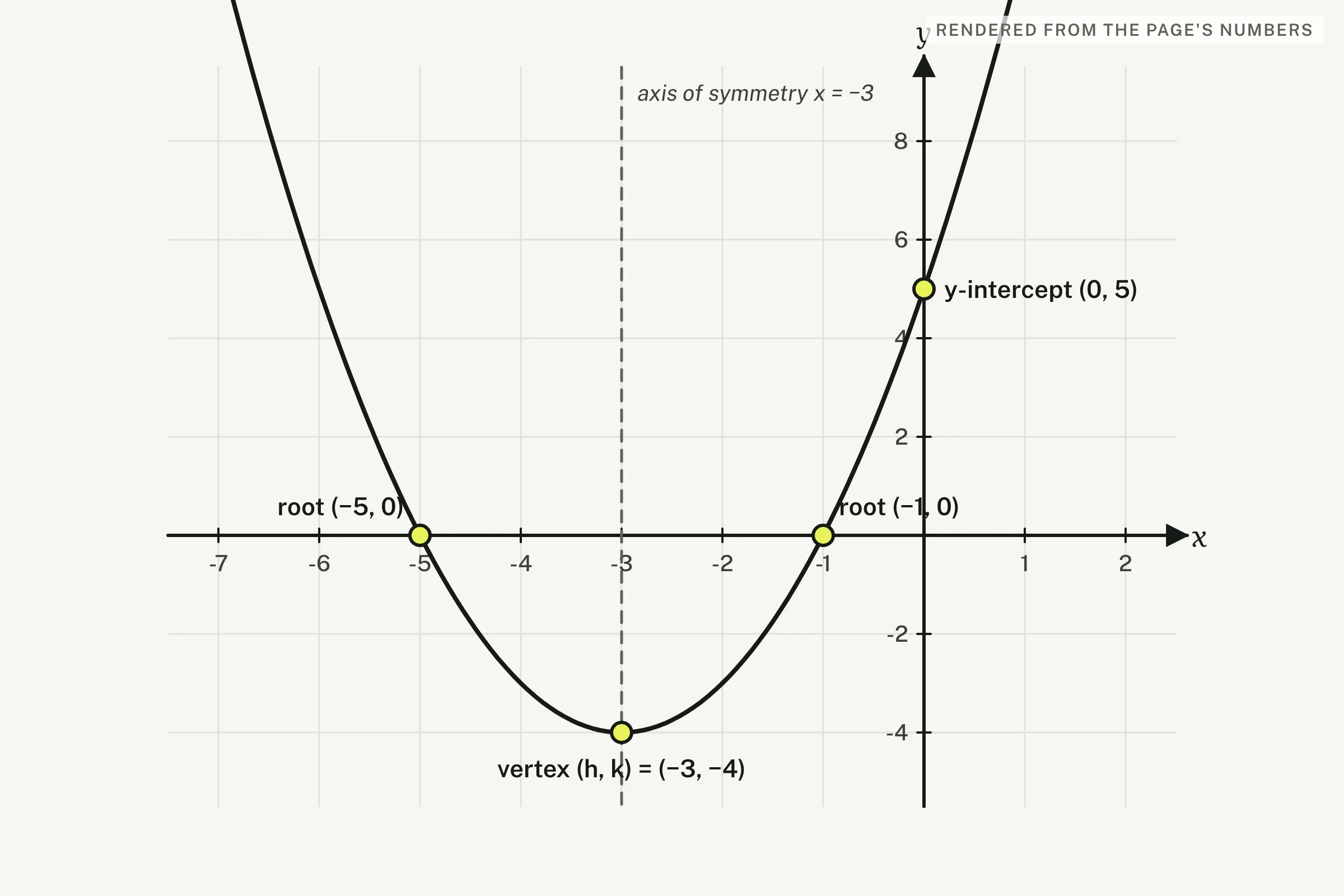
This is the same parabola every one of the different forms of quadratic equations describes — the equation just gets rearranged, not changed.
Convert between forms without a calculator
Once you can move fluently between the forms of the quadratic equation, factoring and vertex questions stop feeling like separate topics — they're the same six or seven lines of algebra run in different directions.
Standard to vertex: completing the square, six lines
Completing the square turns standard form into vertex form. Starting from :
- Isolate the variable terms: .
- Take half of () and square it ().
- Add 9 to both sides:
- The left side is now a perfect square: .
- Solve for : .
- Read off the vertex: .
Standard to factored: factoring and the AC method
For , find two numbers that multiply to and add to : that's 1 and 5. So
Vertex to standard: expand and collect
From : expand the square,
Factored to standard: FOIL and collect
From
Which conversion is worth doing on a timed test
Not every conversion is worth the minutes. If the question only asks for the y-intercept, you don't need vertex form at all — standard form already has it. If the question asks for the vertex and the equation is already in standard form with a friendly , complete the square; don't factor first and then guess the midpoint. If the question asks for the roots and the numbers are ugly, skip conversion entirely and go straight to the quadratic formula.
Quadratic equation examples in each form
These examples of quadratic equations cover every combination a test writer reaches for: vs , a positive vs a negative leading coefficient, and a repeated root. Each is an algebraic equation example you can check yourself by substitution.
Standard-form examples (including a = 1 and a ≠ 1)
- (): y-intercept .
- (): y-intercept .
- (, a perfect-square trinomial): y-intercept .
Vertex-form examples (including a negative a)
- : vertex , opens upward.
- : vertex .
Factored-form examples (including a repeated root)
: roots . : roots . - (a repeated root): the parabola touches the x-axis once, at , instead of crossing it.
A random quadratic equation, worked cold
Take a random quadratic equation with no special setup: . Here , , . The discriminant is
Solving with the quadratic formula
Standard form feeds the quadratic formula directly: read , and off and substitute them into
When to use the quadratic formula vs factoring vs completing the square
When to use quadratic equation methods like factoring versus the formula comes down to one quick check on the coefficients, not a memorized rule.
| Check | Do this |
|---|---|
| splits into two integers that add to | Factor |
| The question asks for the vertex, maximum, or minimum | Complete the square |
| Nothing factors and the numbers are ugly | Use the quadratic formula |
Factor first if the numbers are friendly
Try factoring before anything else when and looks like it splits cleanly — it's the fastest path and needs no formula at all.
Complete the square when the question wants the vertex
If the question explicitly asks for the vertex, the maximum height, or the axis of symmetry, complete the square directly rather than factoring and then hunting for the midpoint of the roots.
Use the formula when nothing factors
The quadratic formula always works, for any , , — including when the roots are irrational or complex. Use it as the fallback the moment factoring stalls past a few seconds. Using quadratic equation methods interchangeably like this becomes automatic once you've run the triage a few times.
The 15-second triage
Glance at first. If two integer factors of obviously add to , factor. If not, and the question wants the vertex, complete the square. Otherwise, go straight to the formula — don't burn a minute testing factor pairs that were never going to work.
Forming a quadratic equation from roots or from a word problem
Forming a quadratic equation runs every conversion above in reverse — starting from what you know about the graph, not from the equation itself.
From two roots: the reverse of factored form
Given roots and , reverse factored form:
From a vertex and a point
Given vertex and a point on the parabola, start from vertex form: . Substitute the point: , so , and . The equation is , or in standard form, . Plotting a vertex from a point this way uses the same skills as coordinate-plane work in geometry.
From a projectile-height word problem
Projectile height follows
Practice questions for quadratic equations, with answers
The questions for quadratic equation practice below mirror what shows up on a chapter test: identify, convert, then solve. Answers are given directly under each item.
Identify the form (6 items)
- — Answer: standard.
— Answer: factored. - — Answer: vertex.
- — Answer: standard (also factorable as ).
- — Answer: vertex.
— Answer: factored.
Convert the form (4 items)
- Convert to factored form. — Answer:
. - Convert to vertex form. — Answer: .
- Convert to standard form. — Answer: .
- Convert
to standard form. — Answer: .
Solve by the best method (6 items)
- — Answer: factor; .
- — Answer: factor (perfect square); (repeated root).
- — Answer: isolate and root; .
- — Answer: formula; .
- — Answer: formula; .
- — Answer: formula; discriminant , complex roots .
When the quadratics unit is graded and there are forty of them
The forms themselves are learnable in an evening — one example, three rewrites, and the pattern sticks. A problem set with forty conversions and word problems due by Thursday is where most students go looking for someone to work the math set instead of grinding through every item by hand. GradeDraft's math desk, part of our do my homework service, solves quadratics problem sets — conversions, the formula, word problems, and the practice-bank style items above — with every step shown, not just a final answer, priced from $25 per problem after a quick look at the set.
Send the assignment or a photo of it. You'll get a per-problem quote back within 2 hours (8 am–11 pm ET) and full worked steps with the delivery, the same format used above.
Get your quadratics problem set solvedFor the algebra that comes before quadratics, see solving linear equations step by step and solving systems by elimination. If your course runs the CPM curriculum, CPM Algebra 2 homework help covers the same forms in that textbook's notation. Quadratics also show up outside math class: a chemistry equilibrium problem often reduces to one, and the bowed-out shape of an economics production possibilities frontier draws on the same curve, covered in the factors-of-production guide.
Free practice banks like Albert.io, Cuemath, Vaia, Expii, and Media4Math cover similar problem types, and graphing the result in Desmos or GeoGebra is a fast way to check any conversion above by eye.
FAQ
More on quadratics: quick answers
Replies within 2 hours, 8 am–11 pm ET, 7 days a week
01What is a quadratic equation?
A quadratic equation is any equation of the form with — an equation where the variable's highest power is 2. It can appear in standard, vertex, or factored form, and solving it means finding the x-values that make the equation true, which are also where the related parabola crosses the x-axis.
02What is the quadratic formula used for?
The quadratic formula,
03What does "quadratic" mean?
"Quadratic" comes from the Latin quadratus, meaning "square" — a reference to the squared variable term, not to four of anything. The meaning of quadratic formula, then, is literally "the square-related formula": it exists because is the term that makes an equation quadratic in the first place.
04What is the discriminant used for?
The discriminant, , is the part of the quadratic formula under the square root. Its sign tells you what kind of roots the equation has before you finish solving: positive means two real roots, zero means one repeated real root, and negative means two complex roots.
05Can a quadratic equation have no real solution?
Yes. When the discriminant is negative, the parabola never crosses the x-axis, and the two solutions are complex numbers instead of real ones. The equation still has exactly two solutions — they're just not points you can plot on a standard x-y grid.
06How many solutions does a quadratic equation have?
Exactly two, counting a repeated root twice and complex roots as valid solutions. A quadratic can look like it has one solution (a repeated root) or zero real solutions (complex roots), but algebraically it always has two, by the same logic as the fundamental theorem of algebra.
07What's the difference between a root, a zero, and an x-intercept?
None, for a quadratic — they're three names for the same value. A root (or zero) is a solution to ; the x-intercept is the graphical version, the point where the parabola crosses the x-axis. If is a root, then is an x-intercept.
08Do you always have to use the quadratic formula?
No. Factoring is faster whenever the numbers cooperate, and completing the square is faster whenever the question specifically wants the vertex. The formula is the one method guaranteed to work on every quadratic, which is why it's the fallback rather than the first move.